In 2026, short-form video dominates the digital landscape, commanding 82% of all internet traffic. With YouTube Shorts generating over 70 billion daily views and TikTok capturing a massive 40% market share (2.051 billion active users), the opportunity for reach has never been higher.
However, visibility is no longer about expensive camera gear or massive production budgets. It is entirely a game of viewer retention and human psychology.
If your Instagram Reels, TikToks, or YouTube Shorts are stalling out at a few hundred views, the problem isn’t your niche, it is your first three seconds.
The New Rules of Viral Short-Form Video
The algorithms governing short-form platforms underwent a major shift following updates in late 2025. Recycled trends, generic lip-syncing, and hyper-polished corporate videos saw a 40% to 60% drop in algorithmic reach overnight.
Today, the dominant ranking signals prioritize originality, raw authenticity, and viewer completion rates. Data reveals that:
- 71% of viewers decide within the first 3 seconds whether to keep watching or swipe away.
- Authentic, unpolished user-generated content (UGC) performs 60% better than overly produced commercial videos.
- More than 50% of all platform engagement goes to everyday creators rather than corporate brand accounts.
To break through the noise, you cannot simply publish more content; you must publish highly strategic scripts built for modern attention spans.
The 4-Part Viral Script Anatomy
The highest-performing short-form videos across a sample of over 118,000 viral clips follow a strict structural framework. If you want to sustain a 70%+ completion rate, the golden threshold required for an algorithmic push, your script must follow this timeline:
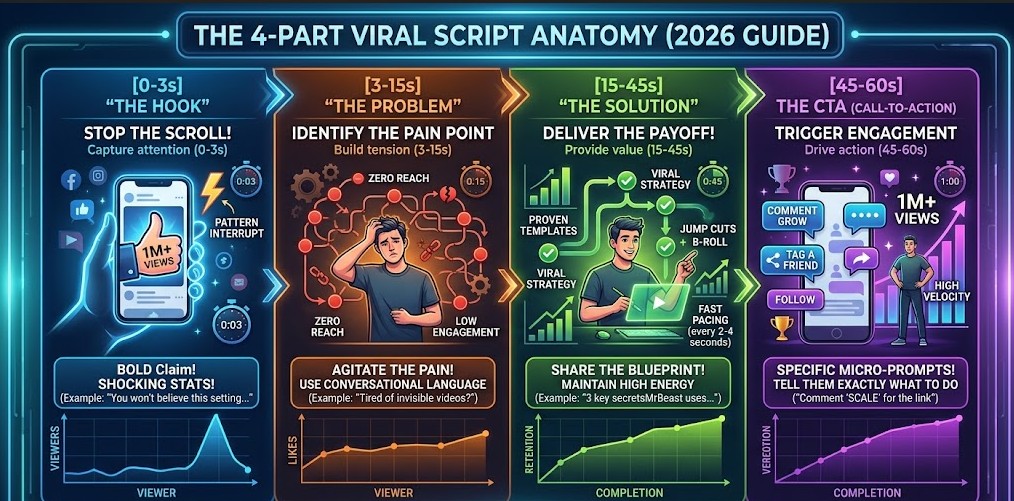
Here is an expanded, highly detailed breakdown of the 4-part viral script anatomy, packed with actionable tactical advice, data-backed metrics, and psychology tricks you can use immediately.
10 Battle-Tested Hook Templates (With Real Examples)
These ten framework templates leverage deep psychological triggers, such as loss aversion, information gaps, exclusivity, and social proof, to maximize watch time.
1. The Hook (0–3 Seconds): The Battle for the Thumb
Your only goal here is to disrupt the user's dopamine-driven scrolling trance. If your hook fails, the rest of your video literally does not exist to the viewer. You aren't just competing with other creators in your niche; you are competing with texts from their friends, breaking news notifications, and the platform's hyper-optimized feed.
The Psychology of Neural Hijacking
To stop a thumb mid-swipe, your hook must trigger an involuntary orientation response in the brain. This is done through three primary execution styles:
The Conceptual Pattern Interrupt: Say or show something that defies normal expectations. If you are a finance creator, don't start at a desk; start by physically ripping a dollar bill in half. The brain demands to know why its predicted reality was broken.
The Curiosity Gap: State a compelling premise while withholding the core mechanism. ("This hidden iPhone feature completely changes how you take photos, but Apple hides it in your settings...")
The Aggressive Audience Filter: Name the exact person you want. ("If you're a freelance graphic designer making under $5k a month, stop scrolling.") This forces immediate self-identification.
Technical & Visual Optimization
The First-Frame Rule: Ensure the first frame of your video has high contrast, clear lighting, and an explicit, bold text overlay (burned-in title) that can be read in less than 0.5 seconds.
Audio Framing: Start speaking on frame 0.01. Never include an intro animation, logo splash screen, or a breathy "Hey guys..." Strip all silence from the first second.
2. The Problem (3–15 Seconds): Agitating the Emotional Pain Point
Once you have caught their attention, you have roughly 10 seconds to prove that staying will be worth their time. This is where you transition from curiosity to active resonance by describing a problem so accurately that the viewer feels personally understood.
Empathy-Driven Agitation
Don't just state a problem dryly; ground it in an everyday emotional reality.
Weak Problem: "Many people struggle to lose weight because of slow metabolisms."
Viral Problem: "You've been hitting the gym five days a week, drinking your water, but you still wake up, look in the mirror, and see the exact same number on the scale. It's frustrating, and it feels like your metabolism is broken."
Strategic Script Pacing & Word Economy
At an optimal, high-energy talking speed, the sweet spot for short-form video delivery is roughly 130 to 150 words per minute.
For this 12-second window, you have a hard ceiling of 25 to 30 spoken words.
Every single syllable must earn its place. Cut out filler words like "um," "so," "honestly," and "basically." Write your script exactly how people talk or text, using short, punchy sentence structures.
3. The Solution (15–45 Seconds): The "Value Bomb" Delivery
This is the core engine of your video. The algorithm rewards content that satisfies the viewer's implicit expectation set by the hook. If your hook promises a secret hack and your solution is generic advice, the viewer will swipe away, sending a negative retention signal to the algorithm.
Retention Mechanics & Preventing Visual Fatigue
The human eye adapting to short-form media gets bored incredibly fast. If you leave a static, talking-head camera shot on screen for more than 3 to 4 seconds, your retention graph will fall off a cliff. To maintain an optimal 70%+ watch-through rate, employ the "Reset Rule":

Pacing & Cuts: Use rapid jump cuts to slice out the microscopic pauses between sentences. Every 2 to 4 seconds, something visually must change on screen.
The B-Roll Matrix: Never talk about an object or concept without showing it. If you mention "productivity apps," cut to a screen-recording of the app interface instantly. Use high-quality, relevant B-roll to give the viewer's eyes something new to process.
Nested Curiosity Loops: Keep viewers from leaving early by throwing out micro-hooks inside the solution. ("Tip number two is what actually doubled my revenue, but first, look at tip number one...")
4. The Call-to-Action (Final 5 Seconds): Triggering Engagement Velocity
The final seconds of your video dictate its algorithmic trajectory. If your video holds amazing retention but generates zero engagement signals (shares, saves, comments), the platform will stop pushing it out.
The Death of Passive CTAs
Phrases like "Thanks for watching, like and subscribe for more" are conversational white noise. Viewers have developed psychological blindness to them and will swipe away instantly. Your CTA needs to feel like an interactive next step rather than a marketing demand.
High-Velocity Micro-Prompts
Use targeted prompts engineered to manipulate specific platform metrics:
To Drive Shares (The Relatability Play): "Tag that one friend who is always late to every single meeting." (Triggers instant peer-to-peer amplification).
To Drive Saves (The Resource Play): "This list updates next week, so save this video right now so you don't lose the links." (Saves are highly weighted signals on Instagram Reels).
To Drive Comments & Automation (The Keyword Play): "Comment the word 'SCALE' below and my automation tool will DM you the step-by-step PDF framework for free." (This explodes the comment section, signaling massive engagement velocity to the platform within the crucial first 24 hours).
Platform-Specific Optimization Matrix
A single script format does not fit all channels. To maximize your reach, adapt your pacing and presentation style to match the specific culture of each platform:
| Platform | Optimal Hook Window | Ideal Total Length | Aesthetic Style & Pacing |
|---|---|---|---|
| TikTok | 0–2 Seconds | 15–30 Seconds | Lo-fi, high-energy, rapid delivery (+20% conversation speed), heavily trend-driven. |
| Instagram Reels | 0–3 Seconds | 30–90 Seconds | Clean, visually cohesive, focus on high-value educational or aesthetic content. |
| YouTube Shorts | 3–5 Seconds | 50–60 Seconds | Narrative-driven, searchable concepts, highly structured storytelling with burned-in captions. |
Advanced Retention Strategies: Beating the Drop-Off
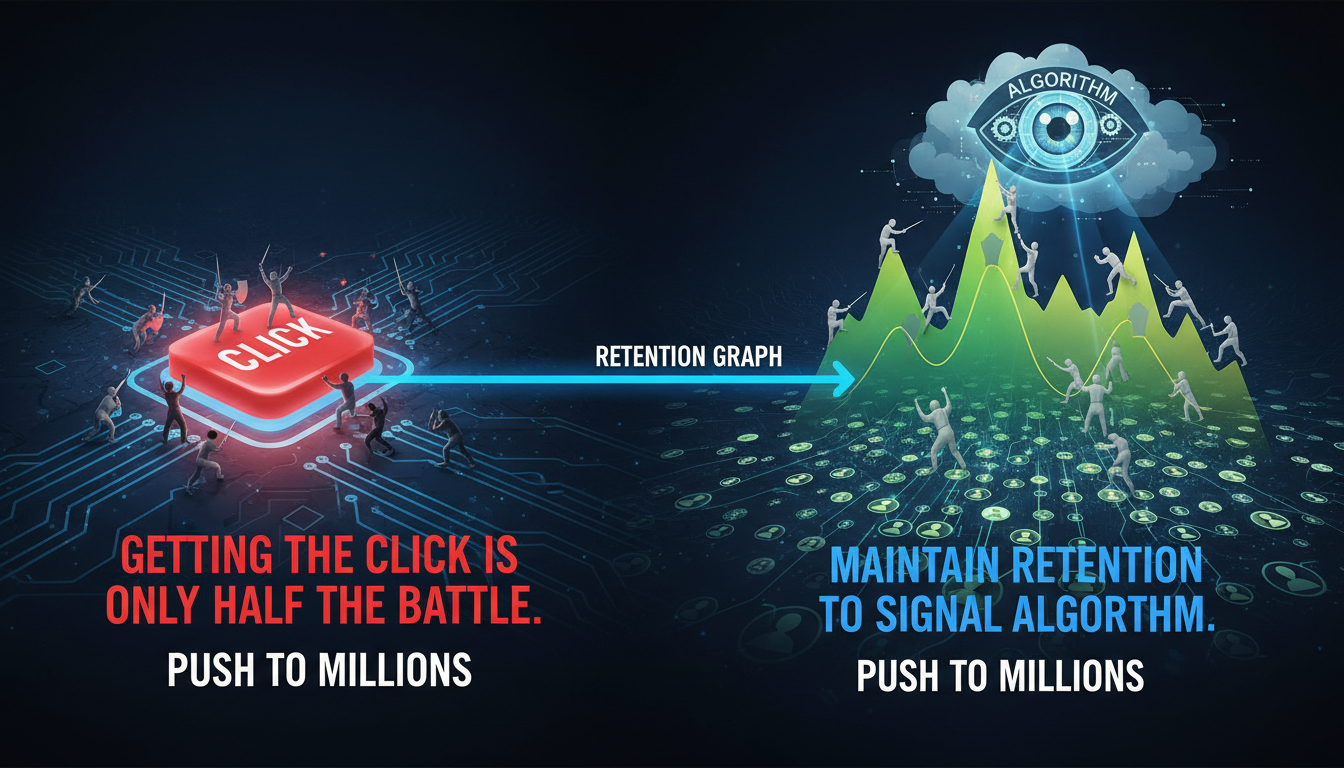
Getting the click is only half the battle. To signal the algorithm to push your video to millions, you must maintain your retention graph.
Visual Dynamics & On-Screen Captions
Because 85% of short-form videos are consumed with the sound turned off, burned-in, dynamic captions are non-negotiable. Use bold, clear fonts where key phrases change colors or scale up. Furthermore, social media search engines parse on-screen text to categorize your content, meaning captions double as a powerful SEO ranking signal.
Open and Closed Information Loops
Keep viewers hooked by opening mini-cliffhangers throughout your video.
Example: "I’m going to show you the tool that fixes this in 10 seconds, but first, you have to understand why this mistake happens."
By constantly opening a new loop before closing the previous one, you keep the viewer mentally engaged and less likely to swipe away.
Leveraging AI Workflows Without Losing Authenticity
The tools available to creators in 2026 have streamlined production significantly, allowing users to save 40% to 60% of their initial writing time. However, data shows that 97% of top-tier creators still maintain a human-in-the-loop editing process to protect their authenticity.
The Optimal 3-Step AI Workflow
Research & Ideation (Gemini): Use live-search connected models to extract accurate data points, trending news, and fact-checked statistics within your niche.
Drafting & Scripting (ChatGPT or Blipix): Use explicit prompt frameworks to generate initial concepts.
Prompt Blueprint: "Write a 45-second TikTok script for [Target Audience] tackling [Specific Problem]. Structure it strictly using a Hook, Problem, Solution, and CTA format. Maintain a high-energy, conversational tone at a 6th-grade reading level."
The Human Polish: Review the output out loud. Strip away any robotic phrasing, add your personal anecdotes, and ensure the final delivery feels like a real conversation with a friend rather than a marketing presentation.
Action Plan: Write Your Next Script Today
Spy on Native Search: Look at the top-ranking videos under your niche's core search terms on TikTok and YouTube. Identify the common denominators.
Select Your Template: Choose one of the 10 hook frameworks above that naturally aligns with your topic.
Write to Trim: Draft your script following the Hook ➔ Problem ➔ Solution ➔ CTA structure. Keep it under 100 words for a standard 45-second video. Eliminate any filler words.
Plan Your Interrupts: Mark your script script every 3 seconds with a visual cue, whether it’s a zoom, an on-screen graphic, or a cut to B-roll.
Publish and Analyze: Do not judge success by a single video. Post 3 to 5 variations utilizing different hooks, then study your platform retention graphs to see exactly where your audience drops off. Refine your next asset based on cold data.