On 17 and 18 October 2026 we made one faceless history Short in Blipix, from a blank form to a downloaded MP4, and wrote down every number along the way: what we clicked, what the AI got wrong, what we fixed, how long each step took and how many credits it used. The finished video is 49 seconds long, it is about the Library of Alexandria, and it cost 21 credits, 10 of them on a draft we deleted.
We build Blipix, so read this as a maker's log, not a neutral review. We left in the parts that make the tool look worse, because those are the parts you need to know before you make a history video of your own.
In short
- The AI-written draft from the Prompt template opened with a claim the evidence doesn't support, so we deleted it and wrote our own 139-word script. For history, treat AI text as a first draft.
- Our script became 11 scenes and 49 seconds of narration with the Onyx voice, about 168 words a minute.
- Editing a scene's text is free but changes only the captions. Re-recording the narration costs 5 credits, and we skipped it, so one scene's captions and voice now disagree.
- Total: 21 credits with the deleted draft, 11 without it. At the Creator plan's price on 18 October 2026 that is about $1.37 or $0.72. Rendering was free and took 84 seconds.
Why we picked the Library of Alexandria
History is a popular faceless niche, and it is where a confident narrator reading a wrong fact does the most damage: viewers repeat it, and the comments fill with corrections. We wanted a topic with a popular myth and a messier record, to see whether an AI tool would repeat the myth, fix it or invent a new one.
The Library of Alexandria fits. The popular version is one great fire. The record is two library sites, a fire in 48 BC that ancient writers describe differently, centuries of slow decline and an end that nobody dated. Our interesting history niche page explains how its preset picks documented events and how to verify them.
Attempt 1: the AI draft we threw away
We started the way most people would, with the Prompt template in the faceless video generator and a single line of input: "The rise and fall of the Library of Alexandria". The other settings:
- Art style: Cinematic, whose card in the picker says "Best for: movie-style stories, history & documentaries".
- Voice: Onyx, a male voice the app labels "Authoritative, Documentary".
- Music: the "Quiet before storm" track.
- Length and format: 30 to 60 seconds, which costs 10 credits, in 9:16.
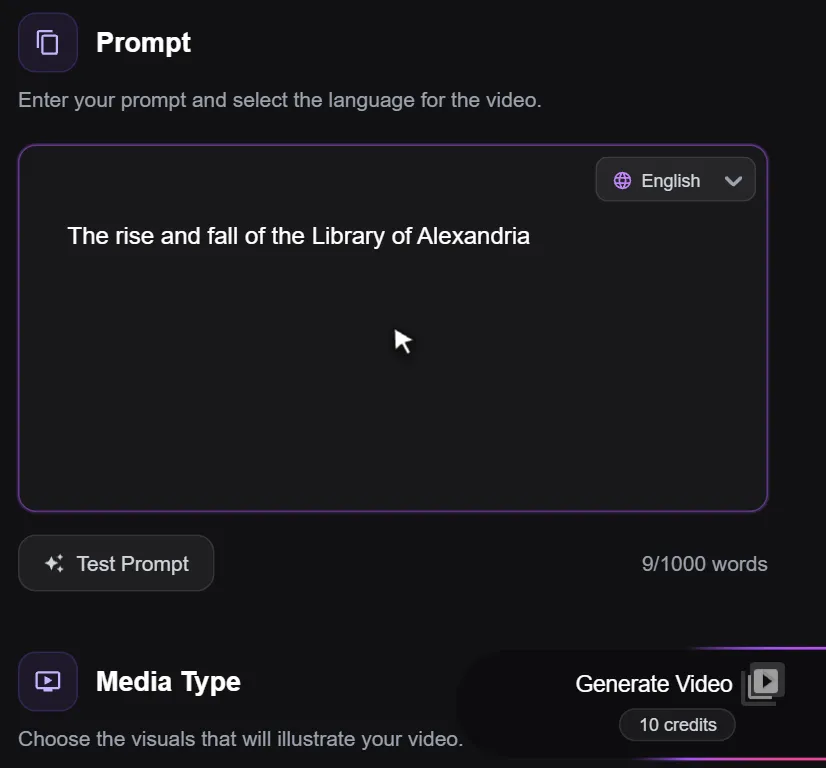
The editor opened about 12 seconds after we clicked Generate, while the scene images were still being drawn. You can already read and edit the script at that point, and that is the moment to check it.
The AI titled its draft "The Library of Alexandria Was Traded, Not Burned". The first line said the library "was not just lost" but "traded". Scene 2 read: "Imagine scholars moving from scroll rooms to ship cabins because patrons demanded proof, not poetry."
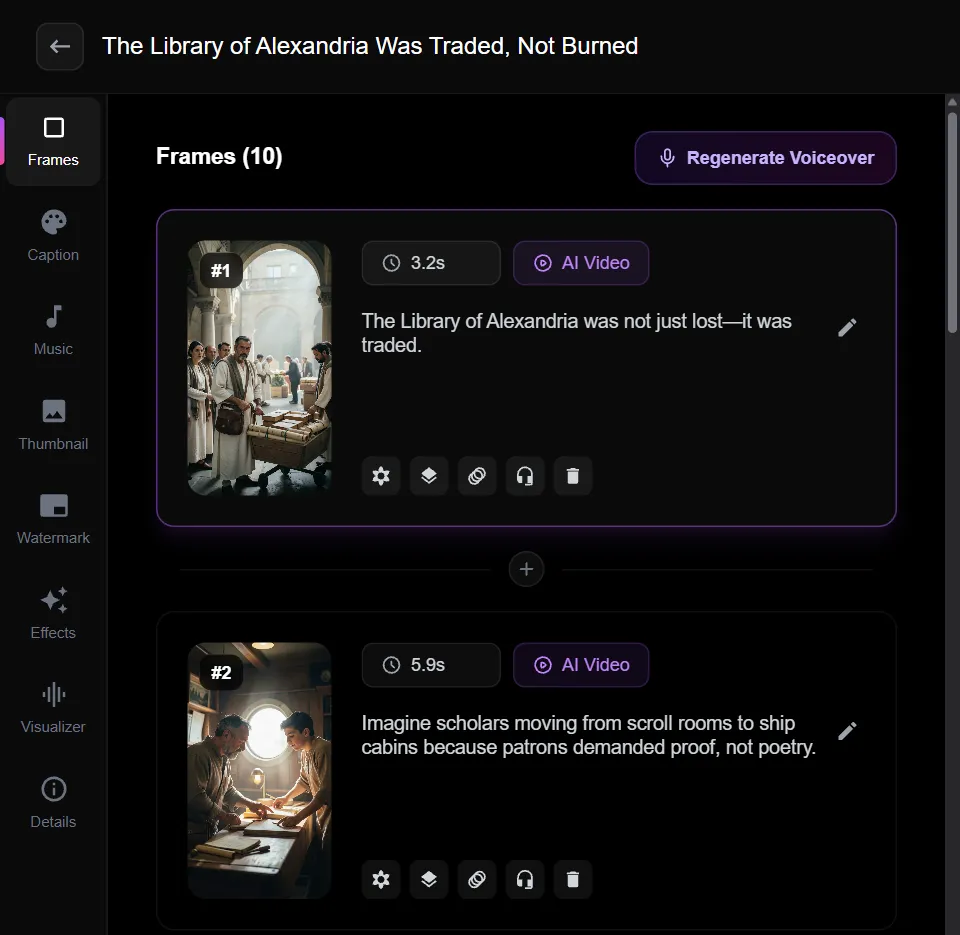
Neither line survives a check. There is a real trading story nearby: the Ptolemies bought books aggressively and kept originals they had borrowed (more on that in the fact-check). But no source says the library ended because it was traded away, and the title sells that idea as the answer to the mystery. The second line sounds like history yet contains nothing you could verify. Which scholars, which ships, which patrons?
Almost every sentence needed rewriting, and each rewrite would also have needed the narration re-recorded at extra cost (see the editing section), so we deleted the draft. The lesson: for history, an AI script is a first draft from a writer who doesn't know where the evidence is thin. Check every line against a source, or write the script yourself.
There was a cheaper way to use AI here, which we found afterwards. The Script template has an AI Script Writer button that writes a draft into the script box, and drafting there uses no credits (we checked the app's code in October 2026). You pay only when you generate the video, so you can fact-check the draft first. The Prompt template writes and builds in one step, which is why our bad draft cost 10 credits. The AI Script Writer also has an Additional Knowledge field for source web pages; we didn't test it for this video, so we can't say how closely it follows them.
Attempt 2: our own 139-word script
For the second try we used the Script template, which narrates the text you paste as written, the same flow as our text to video tool. Art style, voice, music and length stayed the same. This is the script:
For about three centuries, the Library of Alexandria held one of the largest collections of books in the ancient world. The Ptolemaic kings sent agents across the Mediterranean to buy scrolls, and books found on ships in the harbour could be copied for the collection. Scholars working there measured the size of the Earth, edited the poems of Homer and catalogued the writers who came before them. Then the library faded instead of vanishing in a single night. Julius Caesar's fire in 48 BC may have burned part of it, royal money dried up, scholars were driven out, and the city was fought over again and again. By late antiquity the great library was gone, and nobody wrote down exactly when. Its lesson is quieter than one famous fire: knowledge lasts only as long as someone keeps copying it.
Four rules shaped it:
- One checkable claim per clause, so each line could be matched to a source.
- Hedges where historians disagree: "about" three centuries, a fire that "may have" burned part of it.
- The myth corrected in the middle, not in the opening, so the first sentence stays a plain statement of fact. It is a soft hook. If you want a sharper one, our hook templates guide has patterns, but make sure the sharper version is still true.
- A closing line that is clearly opinion, phrased as a lesson so nobody mistakes it for a historical claim.
In the Script template, the price depends on length: anything up to 210 words costs 10 credits. On the free plan the script box accepts 112 words, about 45 seconds of narration, so this exact script would need around 27 words cut.
The result, which the app titled "The Library of Alexandria: Knowledge That Vanished Slowly", had 11 scenes and ran 0:49. Scene 1 lasted 5.9 seconds and scene 2 5.3 seconds. Onyx read our 139 words in 49.6 seconds, about 168 words a minute, which gives you a sizing rule for this voice: roughly 140 words fills a 50-second Short.
Fact-checking the script, line by line
We checked each clause against Britannica's article on the library, the World History Encyclopedia entry (Joshua J. Mark, 2023) and one primary source, Plutarch. Some lines hold cleanly, some hold only with the hedge we gave them, and one is opinion.
| Line | Verdict | What the sources say |
|---|---|---|
| "For about three centuries... one of the largest collections" | Holds, rounded up | Britannica dates the founding to about 295 BC. To Caesar's war in 48 BC is about 250 years, and the library probably outlived that. Reported counts run from "more than 200,000" to 700,000 books, so we gave no number. |
| "sent agents across the Mediterranean to buy scrolls" | Holds | Britannica describes buying in Athens and Rhodes, the biggest book markets of the day. World History Encyclopedia says book agents were sent out to buy whatever they could find. |
| "books found on ships in the harbour could be copied" | Holds as a report | The story comes from the physician Galen, writing about four centuries later, and Britannica files it among the "fabulous stories" about the Ptolemies. In it, the library could keep the original and hand the owner the copy, which is harsher than our line. |
| "measured the size of the Earth" | Holds, with a caveat | Eratosthenes, director of the library, worked out Earth's circumference from the sun's angle at Alexandria and Syene. Britannica puts his error between 0.5 and 17 percent, because the length of his unit, the stadion, is uncertain. |
| "edited the poems of Homer" | Holds | Zenodotus, the library's first superintendent from about 284 BC, produced the first critical edition of Homer. |
| "catalogued the writers who came before them" | Holds | Callimachus compiled the Pinakes, a survey of the library's holdings by field, which Britannica notes survives only in fragments. |
| "faded instead of vanishing in a single night" | Holds, but historians split on how | Britannica's article treats the main Royal Library as a casualty of Caesar's war, and the daughter library in the Serapeum as destroyed in 391. World History Encyclopedia argues the main library survived the fire. Neither describes a single night. |
| "Caesar's fire in 48 BC may have burned part of it" | Holds, deliberately hedged | Plutarch's Life of Caesar (chapter 49) says the fire "spread from the dockyards and destroyed the great library". The notes to the 1919 Loeb translation add that the destruction "can have been only partial". |
| "royal money dried up, scholars were driven out, and the city was fought over" | Holds | Ptolemy VIII expelled scholars in 145 BC, Roman support was uneven, the library's district was wrecked in fighting in AD 272 and 297, and the Serapeum fell in 391 (World History Encyclopedia). |
| "nobody wrote down exactly when" | Holds for the main library | No surviving source records its last day. The story that Arab conquerors burned the books in the 640s appears only centuries later, and Britannica calls it a fabrication. |
| "knowledge lasts only as long as someone keeps copying it" | Opinion | Our conclusion, not a sourced fact. |
The two lines that needed the most care were the ships and the fire. Both rest on ancient writers who lived long after the events, and modern historians read them differently. Where that happens, a hedge word ("may have", "could be") is more honest than a confident sentence, and in a 49-second video it costs you two syllables.
Changes in the editor, and the trap in one of them
Rewording a scene changes the captions, not the voice
We made one wording change, in scene 2: "sent agents across the Mediterranean to buy scrolls" became "sent buyers across the Mediterranean to collect scrolls". Clicking the pencil, typing and pressing Save changes is free and instant.
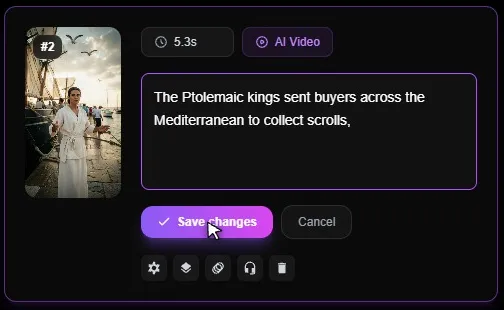
What Save changes does, as we confirmed in the app's code: it updates the scene's text and captions and spreads the new words evenly across the scene's 5.3 seconds. It does not touch the audio. To make the voice match, you click Regenerate Voiceover at the top of the Frames panel, which costs 5 credits, re-records the whole script with your edits and retimes the scenes to the new audio.
We didn't pay for it, which is why our total is 21 credits and not 26. So in the MP4 we downloaded, scene 2's captions read "buyers" and "collect" while Onyx says "agents" and "buy". For a synonym that is a small blemish. For a date, a name or a number it would be a factual error on screen, so after any edit that changes a fact, spend the 5 credits.
Read the captions, not just your script
Two other caption words didn't match what we typed. "Harbour" appeared as "HARBOR", because with the Onyx voice the on-screen words come from a transcription of the recorded narration rather than from your text. "48 BC" appeared as "FORTY-EIGHT BC". Neither is wrong, but if your channel uses British spelling, or you want dates shown as digits, watch the full preview before you render.
A new opening image for 1 credit
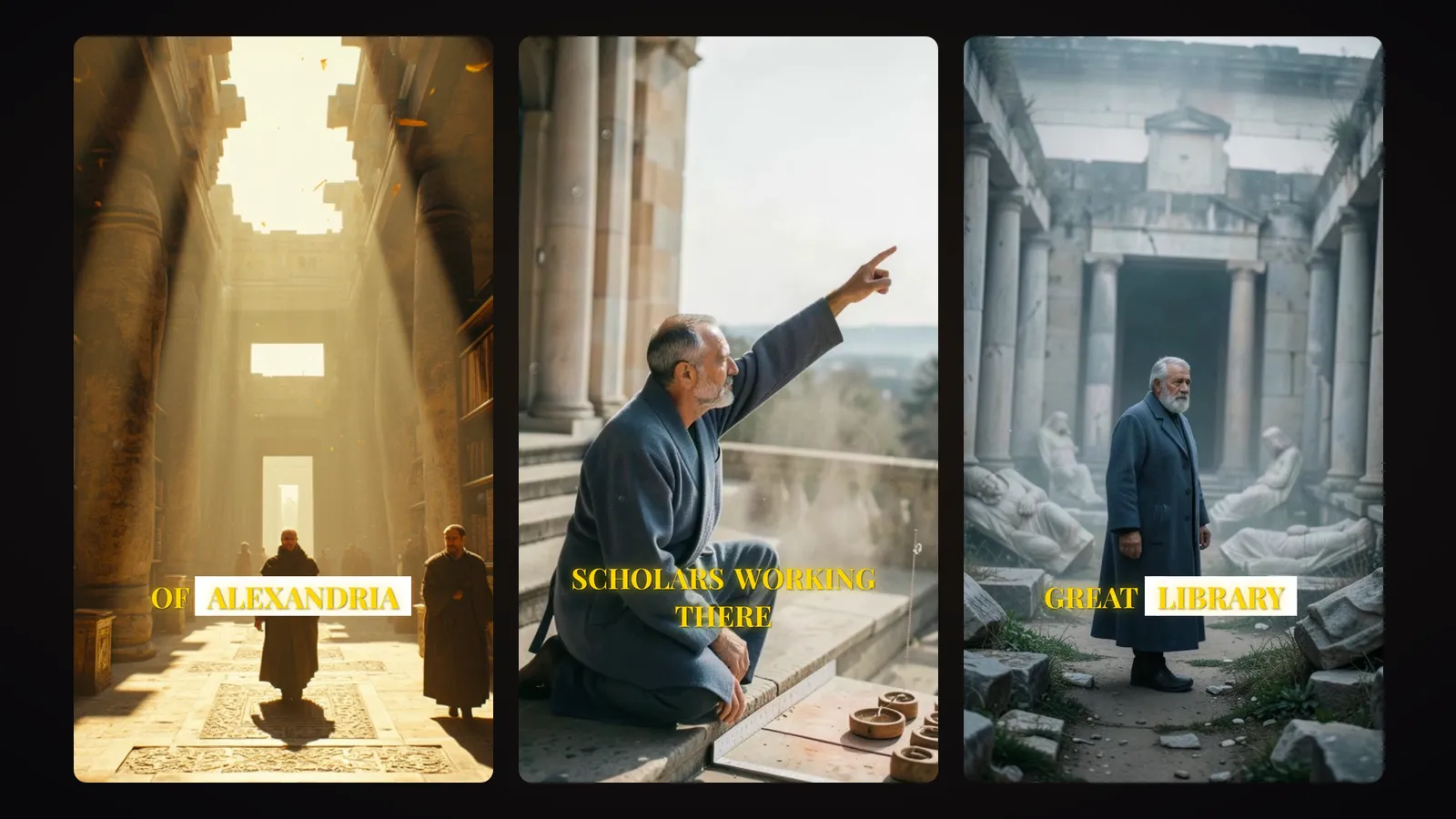
The first frame carries the hook, so it is the one worth a second take. In the Media panel the scene's image prompt was already filled in. We left the default Minimax model selected and generated again: 1 credit, and it took between 25 and 60 seconds. The new take had stronger light and a robed figure walking down the center of a columned hall, and we kept it.
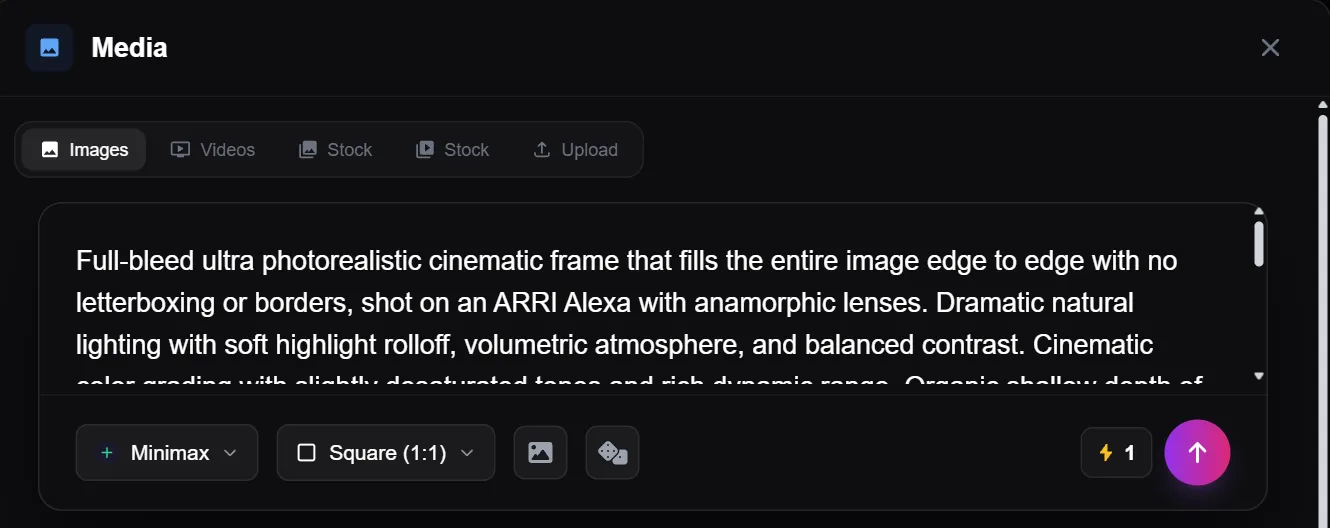
Two details from that panel. The default shape is Square (1:1), and the editor crops it to fill the 9:16 frame, so picking Portrait (9:16) keeps more of what you described. And the Upload tab accepts your own image, which is the right choice for a real artifact or site photo you have the rights to use.
Caption style and music cost nothing
We switched the caption style from BEAST to ROYAL, one of 28 presets, because a gold serif suits an ancient subject better than a heavy display font. We also swapped the music from "Quiet before storm" to "Cinematics". Neither change used credits.
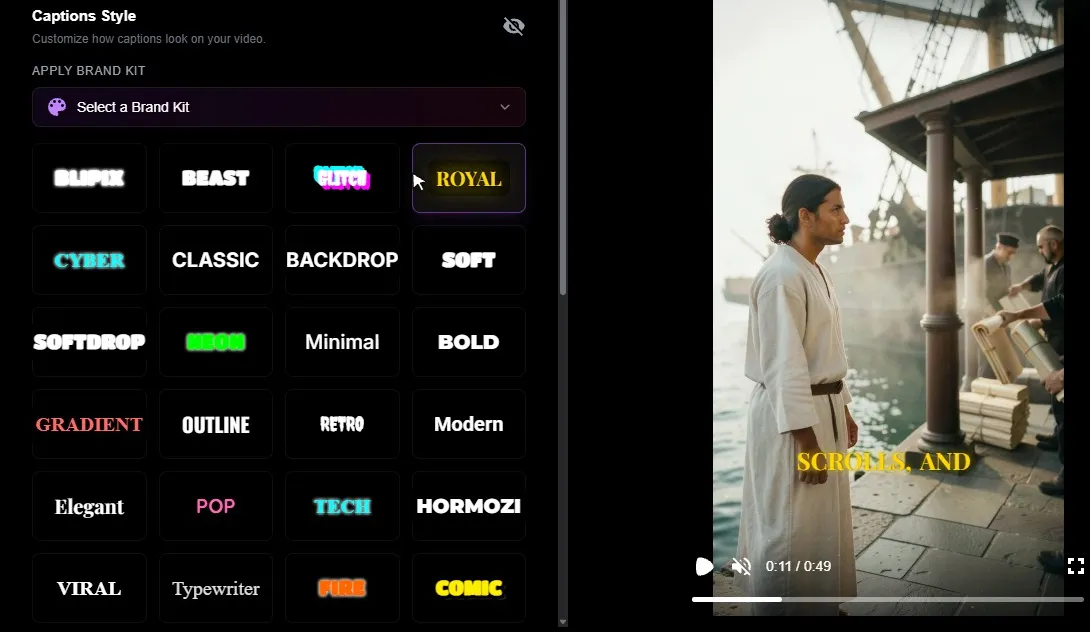
One caveat on ROYAL: the words that aren't highlighted are thin gold letters with no box behind them, and they get hard to read on bright frames such as the harbor scene. Scrub through your lightest scenes before you commit to it.
Render and download: 84 seconds, no credits
Export / Publish opens a two-step panel. Start Render took 84 seconds for our 49-second video, about 1.7 times its length, and used no credits. Download .mp4 then saved a file called video.mp4: 1080 by 1920 pixels, 30 frames per second, about 48 MB.
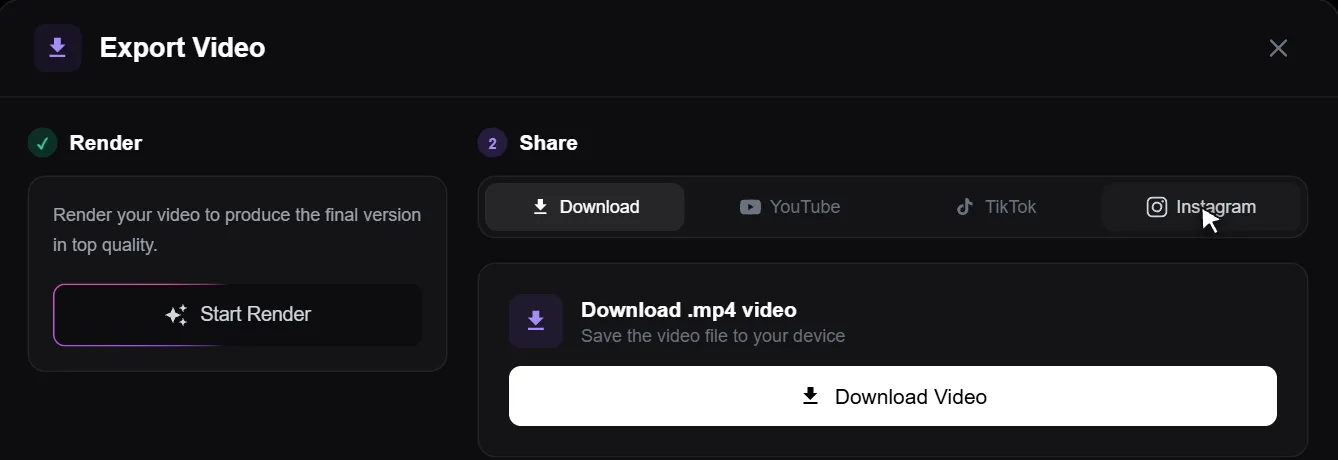
Two plan limits apply here. Downloading and posting need a paid plan; on the free plan you can generate and preview one 30 to 60 second video but not export it. The same panel can post straight to YouTube, TikTok and Instagram (Instagram needs a Business or Creator account), and our YouTube Shorts page covers the upload side. We didn't post this one. If you do, note that YouTube's help page on disclosing GenAI content lists realistic AI footage of a real place among the things to label at upload, as of October 2026, and photoreal scenes of ancient Alexandria are close to that description.
What came out, and what we would still fix
Watched on a phone, the video works. The narration is clear, the pacing is even and the highlighted caption words land on the spoken ones. Watched the way a history fan would watch it, several frames are wrong for the period:
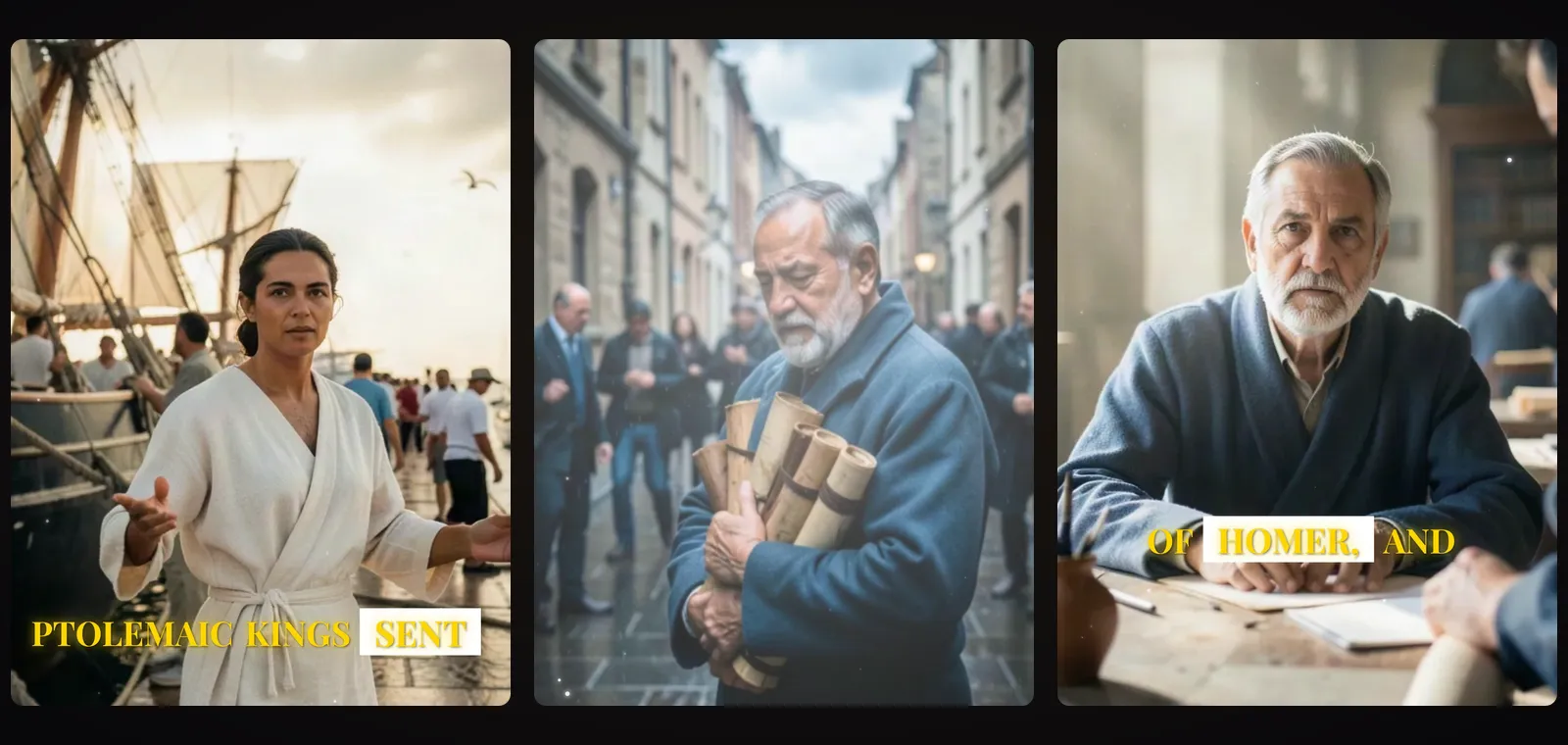
- The harbor scene has sailing ships from a far later age and bystanders in T-shirts and a sun hat.
- The "scholars were driven out" scenes are set in a street of modern stone houses, with men in suits and jeans.
- The scholar who appears in several scenes wears what looks like a wool overcoat, and the Homer scene has a modern notepad and pen on the desk.
- Scene 2's captions still disagree with the narration, as described above.
A better script would not have fixed the pictures. The images follow each scene's text, and our text never said what period people should be dressed for. Next time we would do two things:
- Set the period before generating. The creation form has an AI Image Guidance switch under the art style, with a 200-character field. Something like "Hellenistic Alexandria, 3rd century BC, linen tunics, papyrus rolls, no modern clothing or buildings" goes into every scene's image.
- Fix the worst frames after. Rewrite the image prompt for each bad scene in the Media panel and regenerate it, 1 credit each. The five weakest frames here would cost about 5 credits.
A painted look is the other option. In our view, a style that reads as illustration makes small period errors less jarring than a photoreal frame; the style gallery shows each one on real scenes.
What it cost
| Step | Credits | Time we measured |
|---|---|---|
| Prompt template draft (deleted) | 10 | Editor open after about 12 s |
| Script template video, 139 words | 10 | Same flow as above |
| Scene 2 text edit | 0 | Instant |
| Scene 1 image, Minimax | 1 | 25 to 60 s |
| Caption style and music | 0 | Instant |
| Render and download | 0 | 84 s render |
| Total | 21 (11 without the deleted draft) | |
| Not done: Regenerate Voiceover | 5 | |
| Not done: fixing five period errors | about 5 |
Credits come with a plan, so the fair way to price this is per credit. On 18 October 2026 our pricing page listed Creator at $39 a month for 600 credits, which is 6.5 cents a credit. 21 credits × $0.065 = about $1.37, and 11 credits come to about $0.72. On Pro, $69 for 1,600 credits, the same 21 credits cost about $0.91.
On the free plan, new accounts get 10 starter credits in most countries: enough for one 30 to 60 second video in the Prompt, Script or Preset templates, watermarked, which you can preview but not download. Our project wouldn't have fit. The deleted draft alone used all 10 credits, and the free script box stops at 112 words.
Our checklist for the next history Short
- Collect your sources before you write, and hold every clause to one. A drafting tool such as our YouTube Short script generator can help with structure, not with facts.
- Budget about 140 words for 50 seconds with a documentary voice.
- Name the period, the clothing and what to leave out in AI Image Guidance.
- Read the captions in the preview, and pay 5 credits for a new voiceover after any factual edit.
- Put your sources in the video description, where commenters can check them.