You searched for a Shorts RPM or a "money per view" figure and found a dozen different numbers. None of them come from YouTube. YouTube doesn't pay Shorts creators a fixed rate per view. Instead, it pools Shorts Feed ad revenue and splits it by share of views, per country, per month.
So the honest answer to "how much does YouTube Shorts pay" is a mechanism, not a number. Below, we walk through it using YouTube's help pages as of October 2026. Then we cover the YouTube Partner Program changes announced on August 10, 2026, which take effect February 1, 2027. For the TikTok side, see our companion post.
A note on bias: Blipix is our product and it makes Shorts. The calculators on our site are ours too. We make no earnings claims.
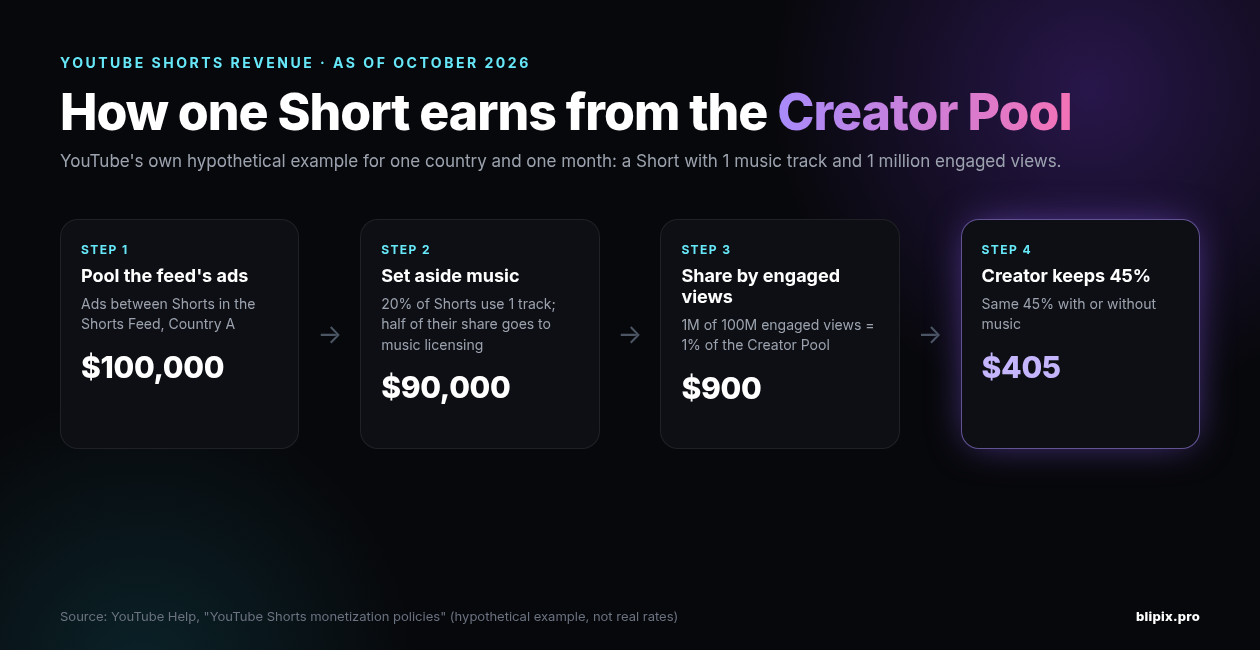 YouTube's own hypothetical example, not a real rate.
In short
- Source: ads shown between videos in the Shorts Feed, pooled each month. Until 2027, no ad is tied to your own Short.
- Split: by your share of eligible engaged views on monetizing creators' Shorts, in each country.
- Your cut: 45% of your allocation. Using music doesn't change your allocation.
- Published: only the method. YouTube publishes no pool sizes, no total views and no rate per 1,000 views.
- From February 1, 2027: you need 10 million qualified Shorts views in the last 90 days to earn from the Creator Pool each month. New channels also face higher entry thresholds.
Where Shorts money comes from
YouTube's Shorts monetization policies put it in one line: "Monetizing partners can earn money from ads that are viewed between videos in the Shorts Feed."
Long-form videos earn from ads on the Watch Page, shown around each video. Shorts views get ad revenue sharing only from the Shorts Feed, which is separate. Because no ad belongs to a particular Short, YouTube pools the feed's revenue and shares it out.
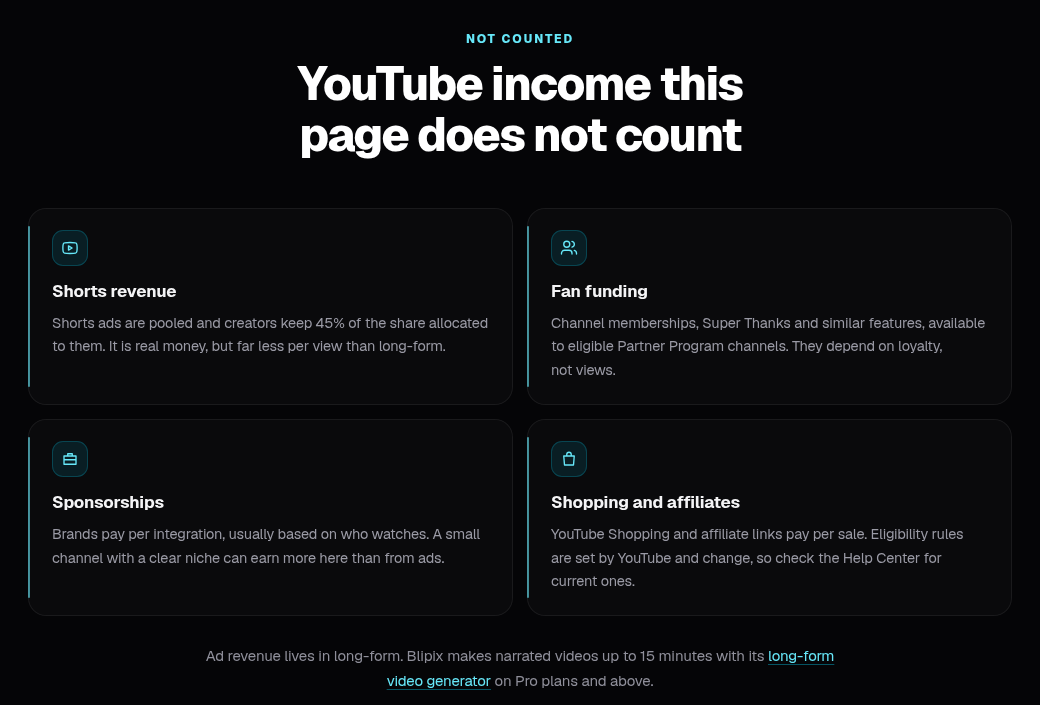
To get any of that money, you must be in the YouTube Partner Program (YPP) and accept the Shorts Monetization Module in YouTube Studio. Views from before the date you accept aren't eligible. If you're not in YPP, you earn nothing from ads shown around your Shorts.
The current entry routes are listed in YouTube's YPP overview:
- 1,000 subscribers plus 4,000 qualified watch hours in the last 12 months, or
- 1,000 subscribers plus 10 million qualified Shorts views in the last 90 days.
Watch hours from Shorts in the Shorts Feed don't count toward the 4,000. Originality matters too. Our post on YouTube's inauthentic content policy covers it for faceless and AI channels.
Premium (including Premium Lite) works in a similar way. YouTube pays 45% of the net Premium revenue allocated to monetizing creators for Shorts, based on each creator's share of subscription Shorts views per country. Part of that revenue covers music licensing.
The Creator Pool, step by step
YouTube describes four steps:
- Pool. Each month, revenue from ads between videos in the Shorts Feed is added together. It's used to reward creators and to help cover music licensing.
- Calculate the Creator Pool. Revenue is allocated by engaged views and music usage across monetizing creators' Shorts. If a Short has no music, all of its associated revenue goes to the Creator Pool. With one track, half goes to the pool, and with two tracks, one third. The rest covers music licensing.
- Allocate. The pool is split by each creator's share of total engaged views on monetizing creators' Shorts in each country. If you have 5% of the views, you get 5% of the pool.
- Apply the revenue share. You keep 45% of your allocation, whether or not you used music.
Music shrinks the pool in step 2, but it doesn't count against you in step 3. In YouTube's words: "Your allocation from the Creator Pool is not affected by your use of a music track."
Here "music" means content made available or claimed by YouTube's music industry partners, or generated by Dream Track. At this time, no other third-party content reduces the pool.
YouTube's worked example
YouTube describes a hypothetical month in "Country A":
- 100 million engaged Shorts views, all on monetizing creators' Shorts;
- $100,000 from Shorts Feed ads;
- 20% of Shorts use one track, so $10,000 covers music licensing and the Creator Pool is $90,000;
- your Short has 1 million engaged views (1%), so you're allocated $900;
- after the 45% share, you earn $405.
That works out to $0.405 per 1,000 engaged views. It's not a real rate and not a forecast. YouTube calls the example hypothetical.
The formula, simplified
This is our simplification of YouTube's description, for one country and one month:
Shorts ad earnings ≈ 45% × (your eligible engaged views ÷ all eligible engaged views on monetizing creators' Shorts in that country) × that country's Creator Pool
It leaves out Premium and, from 2027, targeted Shorts ads. It also has a bigger problem: you only know one of the three inputs. YouTube doesn't publish the pool size or the total views. That's why no one can give you a reliable fixed "per 1,000 views" figure for Shorts.
Which Shorts views don't earn
Payment is based on eligible engaged views. Views that aren't eligible include:
- non-original Shorts: unedited clips from movies or TV, reuploads of other creators' content, and compilations with no original content added;
- artificial or fake views, such as views from click or scroll bots;
- views of Shorts that don't follow the advertiser-friendly guidelines.
Gameplay and story formats are where it's easiest to cross the reused-content line. See our post on Reddit story and gameplay videos.
Some revenue never enters the Creator Pool at all:
- revenue tied to Shorts from creators who haven't accepted the module or aren't eligible (YouTube uses it for music licensing and/or keeps it);
- revenue from Shorts uploaded by music partners;
- revenue from ineligible views;
- ads shown when the Shorts Feed opens, before a Short plays (such as the Shorts Masthead);
- ads on navigational pages in the Shorts player;
- Image Posts.
Your public view count isn't the paid number
Since August 24, 2026, YouTube counts a view the moment a video starts to play. YPP earnings are still based on engaged views, and YPP eligibility on qualified views.
Qualified Shorts views are views of public Shorts in the Shorts Feed. Private, unlisted and deleted Shorts don't count, and neither do ad-campaign views or Image Posts.
Longer Shorts and music claims
YouTube's three-minute Shorts page says square or vertical videos up to three minutes uploaded on or after October 15, 2024 are Shorts. They monetize under the pool model.
A Short over one minute with an active copyright claim of any type is blocked globally. It can't be played or recommended, and it isn't monetized. There's no penalty on your channel, and you can remove the claimed content or dispute the claim. Royalty-free music from the YouTube Audio Library won't receive a Content ID claim.
Reading your own Shorts RPM
Once you're monetizing, YouTube Analytics shows your estimated daily Shorts Feed ad revenue. In the Content section of Studio, Shorts whose views count for revenue sharing don't show a "No ad earnings" notice.
YouTube's ad revenue analytics page defines RPM as revenue per 1,000 views. It includes ads, channel memberships, YouTube Premium revenue, Super Chat and Super Stickers. For Shorts, RPM counts all engaged views.
CPM is what advertisers pay per 1,000 ad impressions. RPM is lower because it's calculated after YouTube's revenue share and includes views that weren't monetized.
Your Shorts RPM can change from month to month because the pool and everyone else's views change. A drop doesn't necessarily mean your Shorts got worse. Allocation is also done per country, so where your viewers are matters.
Our YouTube views calculator won't help here. It's built for long-form only and doesn't model Shorts. The page itself says Shorts views earn far less than its figures.
What changes on February 1, 2027
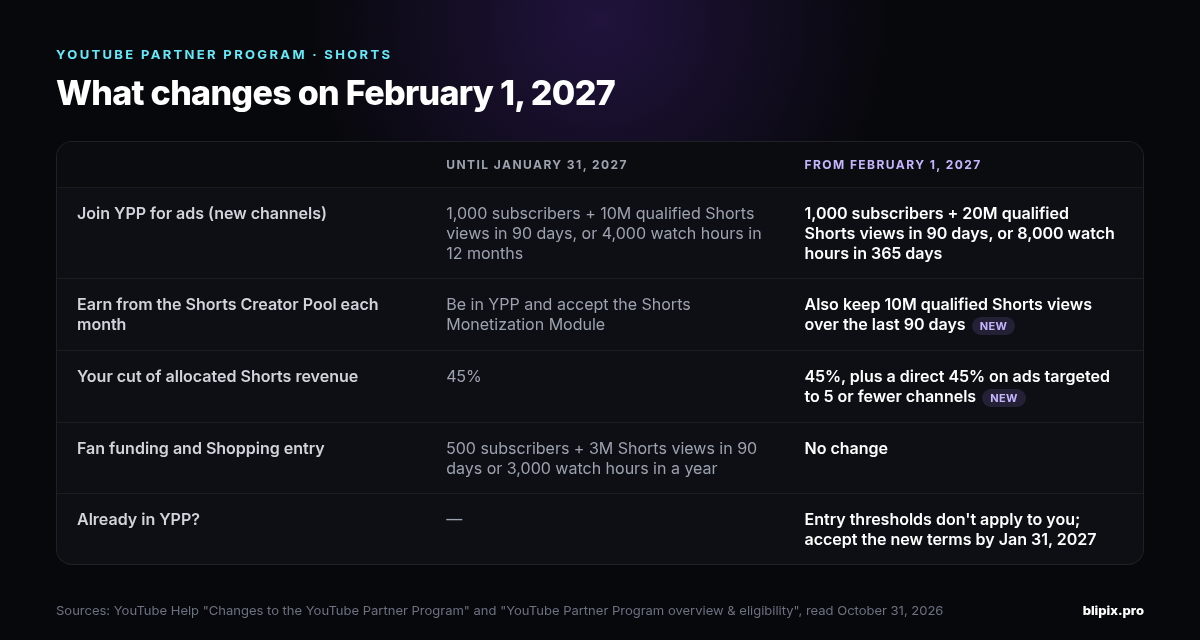
On August 10, 2026, YouTube announced changes to the YouTube Partner Program that start on February 1, 2027. You need to accept the updated terms in YouTube Studio by January 31, 2027. If you don't, you stop earning from the associated features from February 1. You stay in YPP, though, and can accept later to regain access.
The 10 million views rule
This is the biggest Shorts change. To earn Creator Pool and Shorts Premium revenue for a month, you'll need at least 10 million qualified Shorts views in the last 90 days. The 90-day window ends on the 15th of the month before the month being calculated.
Missing the bar doesn't remove you from YPP. It also doesn't affect your other earnings, including long-form. YouTube's announcement post says Shorts revenue sharing resumes automatically once you're back above 10 million. It adds: "Creators who already earn significant revenue from Shorts are unlikely to be impacted by these changes."
Other changes
- Targeted Shorts ads: ads targeted to five or fewer channels earn direct revenue. Creators keep 45% of the net revenue from that ad, on top of the Creator Pool.
- Activity rule: to count as active, a channel needs 1,000 qualified watch hours in 365 days, 1 million qualified Shorts views in 90 days, or 2 long-form videos or 5 Shorts uploaded every 90 days. Channels that drop below get an extended 90-day window to reach the watch-hours or Shorts-views requirement.
- Incentive programs: YouTube says new Shorts programs may offer Shopping bonuses, production credits for brand deals and earnings boosts for cultural trend activations. Details are still to come.
| Until January 31, 2027 | From February 1, 2027 | |
|---|---|---|
| Joining YPP for ads (new channels) | 1,000 subscribers + 4,000 qualified watch hours (12 months) or 10M qualified Shorts views (90 days) | 1,000 subscribers + 8,000 qualified watch hours (365 days) or 20M qualified Shorts views (90 days) |
| Earning from the Creator Pool each month | Be in YPP and accept the Shorts Monetization Module | Same, plus 10M qualified Shorts views in the last 90 days |
| Revenue share | 45% of your Creator Pool allocation | 45% of your allocation, plus 45% of net revenue from Shorts ads targeted to 5 or fewer channels |
| Fan funding / Shopping entry | 500 subscribers + 3,000 qualified watch hours (last year) or 3M qualified Shorts views (90 days) | Unchanged |
| Activity rule | Existing activity thresholds | Any of: 1,000 qualified watch hours (365 days), 1M qualified Shorts views (90 days), or 2 long-form videos or 5 Shorts every 90 days |
| Already in YPP | Current terms apply | Status kept; accept the updated terms in Studio by January 31, 2027 to keep earning from the associated features |
What YouTube does not publish
None of the YouTube pages we read gives:
- the size of the Creator Pool in any country or month;
- total engaged views per country;
- an official or "typical" Shorts RPM;
- a fixed rate per view.
YouTube does share its overall scale: its blog says it gets "over 200 billion daily Shorts views". But it doesn't share the engaged, eligible, per-country totals that the pool is split by.
Any "$X per 1,000 Shorts views" figure you see online is someone's observation, not a YouTube rate. Once you're monetized, the only number to plan with is your own Shorts RPM in YouTube Analytics.
Shorts or long-form for revenue?
- Shorts: a shared pool, split by share of engaged views. Creators keep 45%.
- Long-form: Watch Page ads shown around your own videos. Creators keep 55%.
Premium works on a similar split. According to the YouTube blog, creators share a pool of 60% of net subscription revenue for Premium Lite and 30% for Premium. From that pool, the revenue share is 55% for long-form and 45% for Shorts.
From February 2027, Shorts pool revenue also depends on reaching the 10 million views bar each month. Long-form earnings don't.
We won't put a number on which format pays more per view, because that depends on your own analytics. Many channels use Shorts for reach and long-form for ad revenue, but that's an observation, not a rule.
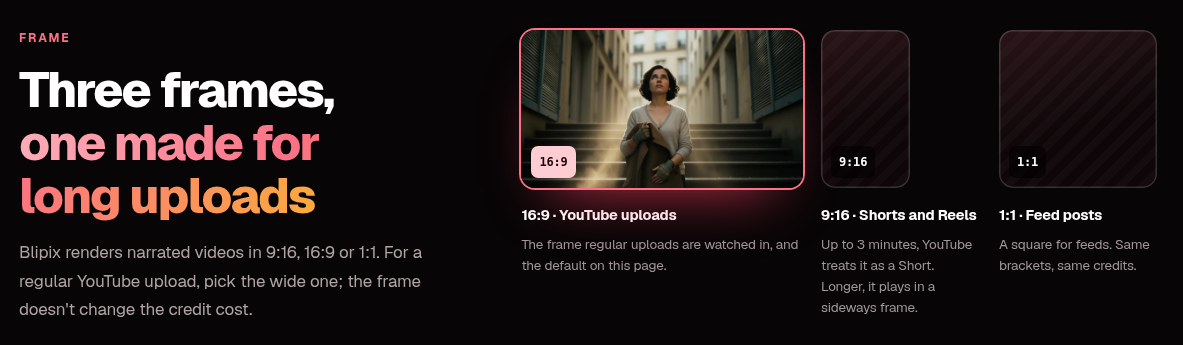
The format of your upload decides which model applies. A square or vertical video of three minutes or less is a Short. A wider ratio such as 16:9 keeps a video out of Shorts.
What this means if you use Blipix
Blipix generates new images and narration from your script and renders videos in 9:16, 16:9 or 1:1. A 9:16 or 1:1 video of three minutes or less is a Short. A 16:9 video is a regular video.
Our Shorts page explains that Blipix's longest setting under the cap is 2.5–3 minutes. A wordy script can push the render past 3:00, so if the video has to count as a Short, check the runtime before you upload.
Posting
Blipix posts through the YouTube Data API, with the video's title, description and privacy setting. Our title, description and tag limits post covers those fields. A series can auto-post once a day, twice a day or three times a week.
Blipix doesn't touch monetization. Applying to YPP, accepting the Shorts Monetization Module and the new terms, and reading your RPM all happen in YouTube Studio.
Music
You can turn music off, pick from the Royalty Free, AI, Commercial and My Music tabs, or upload your own track. Some of our library tracks are instrumentals we generated with an AI music model.
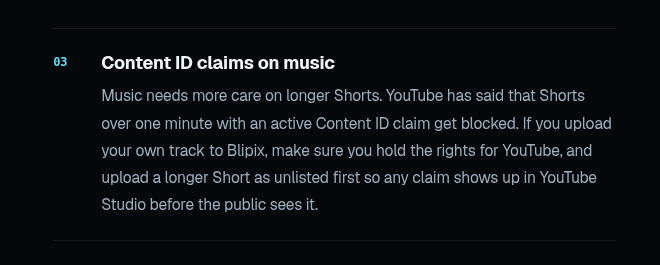
Your music choice doesn't change your allocation. The real risk is a Content ID claim on a Short over one minute, which blocks it. If you upload your own track, make sure you hold the rights for YouTube. Upload a longer Short as unlisted first, so any claim shows up in Studio before the public sees the video.
The honest caveats
- Nothing in Blipix changes how YouTube pays for Shorts. Posting more doesn't change it either. Views of non-original or repetitive Shorts aren't eligible, and from February 2027 the 10 million views bar applies every month. Posting more only helps if each Short is worth watching. See how many Shorts to post a day.
- The script has to be yours. New images and narration only count as a fresh production if the script isn't a rewrite of another creator's video. Our Shorts script generator gives you a first draft, but you have to add your own angle.
- Shorts for reach are fine. If you want Watch Page ad revenue, make 16:9 videos. Long-form videos up to 15 minutes are available on Pro plans and above. See the AI long-form video generator and pricing.
- When Blipix is the wrong pick: a channel whose plan depends on Creator Pool payouts while it's far below 10 million qualified Shorts views per 90 days. After February 1, 2027, those views earn nothing from the pool, whatever tool made them.
If your channel is new, start with our guide to starting a faceless YouTube channel.
FAQ
How much does YouTube Shorts pay per 1,000 views?
YouTube doesn't publish a rate. Your Shorts RPM depends on the pool and on total views in each country. Once you're monetized, use your own figure in YouTube Analytics.
Does music in a Short lower my pay?
No. Your allocation stays the same, and you keep 45% either way. Music only shrinks the Creator Pool. Watch out for claims on Shorts over one minute.
Do views from before I accepted the Shorts Monetization Module get paid?
No. Those views aren't eligible.
What if I'm under 10 million Shorts views after February 1, 2027?
You earn no Creator Pool or Shorts Premium revenue that month. You stay in YPP, and your long-form earnings aren't affected. Shorts revenue sharing resumes once you're back above 10 million.
I'm already in YPP. Do I need to do anything?
Yes, if you want to keep earning from every feature. Accept the updated terms in YouTube Studio by January 31, 2027. The new entry thresholds don't affect your status.