YouTube, TikTok and Instagram don't ban true crime, even when it's a faceless Short with AI images and an AI narrator. They police how it's told: how graphic it is, whether it treats real victims with respect, whether the context sits inside the video, and whether AI makes real people look like they said or did something. Often the cost is an age restriction, fewer ads or no recommendations, not removal.
This guide follows the linked policy pages as of November 2026 and isn't legal advice: defamation and privacy law vary by country, and a lawyer is the right person for a specific case.
YouTube: how much graphic detail you can show
YouTube's violent or graphic content policy bans violent or gory content "intended to shock or disgust viewers", with possible exceptions for "educational, documentary, scientific, or artistic context". Examples include shocking imagery of "physical attacks, immolation, torture, corpses, robberies" and "Footage of corpses with massive injuries, such as severed limbs".
Dramatizations can be removed if viewers lack the context to tell they're fictional. Clearly fictional ones generally stay up but may be age-restricted if graphic, especially with "real human actors" rather than "animations or video games". Our reading: photorealistic AI sits closer to actors.
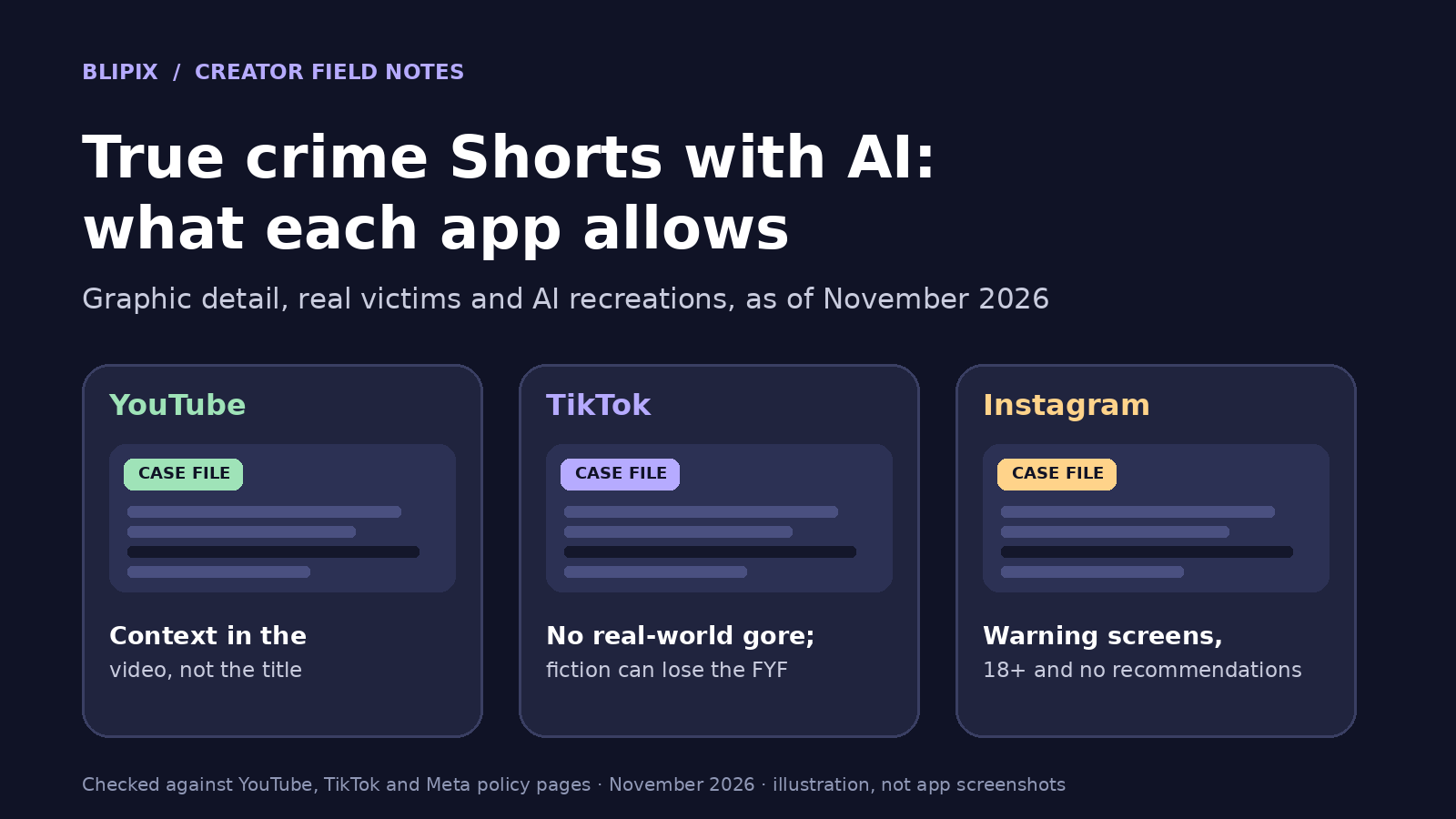
The key rule: for graphic educational content, context "must appear in the images or audio of the video itself. Providing it in the title or description is insufficient." YouTube's educational content page says "We review WHAT context is present and WHERE the context is"; comments, tags or pinned comments may not count. Robbery footage that gives "no education or explanation to viewers" isn't allowed, while the same footage explaining "where and when the crime took place, how it happened, and why the video is posted" can qualify. It may still be age-restricted, hiding it from anyone "under 18 years of age or signed out."
The policy covers thumbnails and descriptions too. YouTube weighs whether violence "is the focus", whether metadata shows "an intent to shock or disgust viewers", whether it's "blurred, masked, or obscured", and how long it lasts. AI disclosure "is not a free pass to violate our policies".
Violations mean removal and an email. A first one likely brings only a warning, which can expire 90 days after you complete a policy training; repeats can lead to strikes and termination.
YouTube: real victims, AI recreations and first-person narration
YouTube's harassment and cyberbullying policy doesn't allow:
- "Content reveling in or mocking the death or serious injury of an identifiable individual."
- "Content that realistically simulates deceased or abused individuals describing their death or violence experienced."
- "Content that denies or minimizes someone’s role as a victim of a well-documented, major violent event."
It also bans "Depicting an identifiable individual being murdered or seriously injured", such as a real person's photo edited onto a movie victim.
So the popular format where a real victim "tells their own story" in the first person, with a realistic AI face or voice, is exactly what the second line describes. Labels don't fix that, and educational exceptions "are not a pass to harass someone."
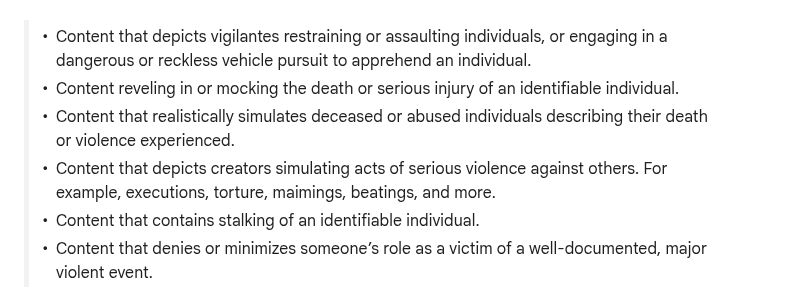
Cropped screenshot of YouTube's public Help Center page "Harassment & cyberbullying policies", taken November 16, 2026.
Families can act too. YouTube's privacy guidelines let people report AI that alters or generates their voice or image without permission; for someone who has died, "A close family member makes the claim". YouTube weighs whether the person is "uniquely identifiable", along with "public interest, newsworthiness, consent". Creators may get time to trim or blur; after a removal, "do not upload another version featuring the same people."
Realistic AI scenes also need YouTube's altered or synthetic disclosure, covered in our AI labeling guide.
YouTube ads: how true crime moves between ad tiers
YouTube's advertiser-friendly content guidelines cover every part of a Short, including "thumbnail, title, description, and tags", and say content "where the focal point is on blood, violence, or injury, when presented without other context, is not suitable for advertising." For death and tragedy:
- Can earn ad revenue (educational or historical content): "Reports of nearby homicide events without graphic descriptions of the casualties", "Fully obscured (such as blurred out), graphic dead bodies", "Implied moment of death or severe bodily harm" in documentary contexts.
- Limited ad earnings: "A documentary on a recent homicide featuring descriptive language of the circumstances of death", "Highly graphic descriptions of tragedies (in the form of audio or video)", "Dead bodies with obvious injury or damage" even in documentaries.
- No ad earnings: "Focus on blood, guts, gore, bodily fluids (human or animal), crime scenes or accident photos with little to no context."
A separate sensitive events policy, covering "mass acts of violence", applies "even if the content contains no graphic imagery."
Our reading: narrating that a death happened puts you in a different tier from narrating how the body looked. For how Shorts ad revenue works, see how YouTube Shorts pay.
TikTok: graphic content, glorification and AI likeness
TikTok's Community Guidelines, released August 25, 2026, took effect September 24, 2026.
Sensitive and Mature Themes bans "anything extremely gory, disturbing, or violent", including real-world "Dead bodies", "the moment of someone's death" and "Graphic injury" such as dismemberment. Significant real-world bleeding is age-restricted and FYF ineligible. Also FYF ineligible: "Fictional graphic incidents, violence, or injury", the build-up to a serious injury even if it isn't shown, and jump scares. Blood in educational or fictional contexts is allowed.
FYF ineligible means the post stays up but isn't recommended in the For You feed. TikTok doesn't say whether AI reconstructions of real crimes count as real-world or fictional; graphic violence is removed or unrecommended either way.
Safety and Civility bans "praising acts of violence" and sharing instructions for crimes, but allows documentary content and criticism. For "Individuals who cause mass or serial violence", it bans praise and showing people, symbols or manifestos linked to them; neutral-looking content "must make clear that there is no intent to promote it". So frame serial-killer episodes as documentary, never admiration. It also bans "Degrading or revictimizing people who have experienced a tragedy", including claiming they deserved it.
Integrity and Authenticity requires labels on AI content showing "realistic-looking scenes or people". Even labeled, it bans "Using the likeness of private figures without consent", "Sexualized, fetishized, or victimizing depictions" and misleading AI showing "A public figure being degraded, harassed, or linked to criminal behavior". Private figures are "All people under 18, and adults who aren't public figures"; likeness includes "face, body, voice, and gestures". Anime styles and generic text-to-speech need no disclosure.
Most true crime victims are private figures, so a realistic AI likeness of one runs into this rule, label or not.
Instagram: warning screens, family requests and recommendations
Instagram follows Meta's violent and graphic content standard, which removes "the most graphic content" and adds warning labels to other content. Videos of dismemberment, visible innards, burning or charred persons, or throat-slitting are banned. A person's violent death, "including their moment of death or the aftermath", gets a warning screen and an 18+ limit; "fictional people" in violent deaths are 18+ too. Imagery or audio of a confirmed violent death isn't allowed once "a family member of the deceased requests its removal."
Instagram's recommendations guidelines hold a "higher standard" because recommendations come from "accounts you haven't chosen to follow". That can exclude "Content that may depict violence, such as people fighting" and content that "depicts or trivialises themes around death". Instagram also hides "most graphic and disturbing imagery from teens". Our reading: since true crime is about death, some of it may not be recommended to non-followers.
The Meta and Instagram pages we read don't mention true crime or AI recreations of victims specifically.
The three apps side by side
| App | Graphic real-world imagery | Fictional or dramatized violence | AI likeness of a real victim | What can cost you reach or ads |
|---|---|---|---|---|
| YouTube | Removed if meant to shock; may be age-restricted instead with in-video context | Generally not removed if clearly fictional; may be age-restricted if graphic | Realistic simulation of deceased victims describing their death not allowed | Limited or no ads for graphic descriptions or gore without context |
| TikTok | Dead bodies, moment of death and graphic injury not allowed | Fictional graphic violence is FYF ineligible | Not allowed for private figures without consent, even labeled | Fictional graphic violence, build-up to injury and jump scares are FYF ineligible |
| Most graphic removed; violent death behind a warning screen, 18+ | Fictional violent deaths limited to 18+ | Not addressed on the pages we read | Violent content may not be recommended; graphic imagery hidden from teens |
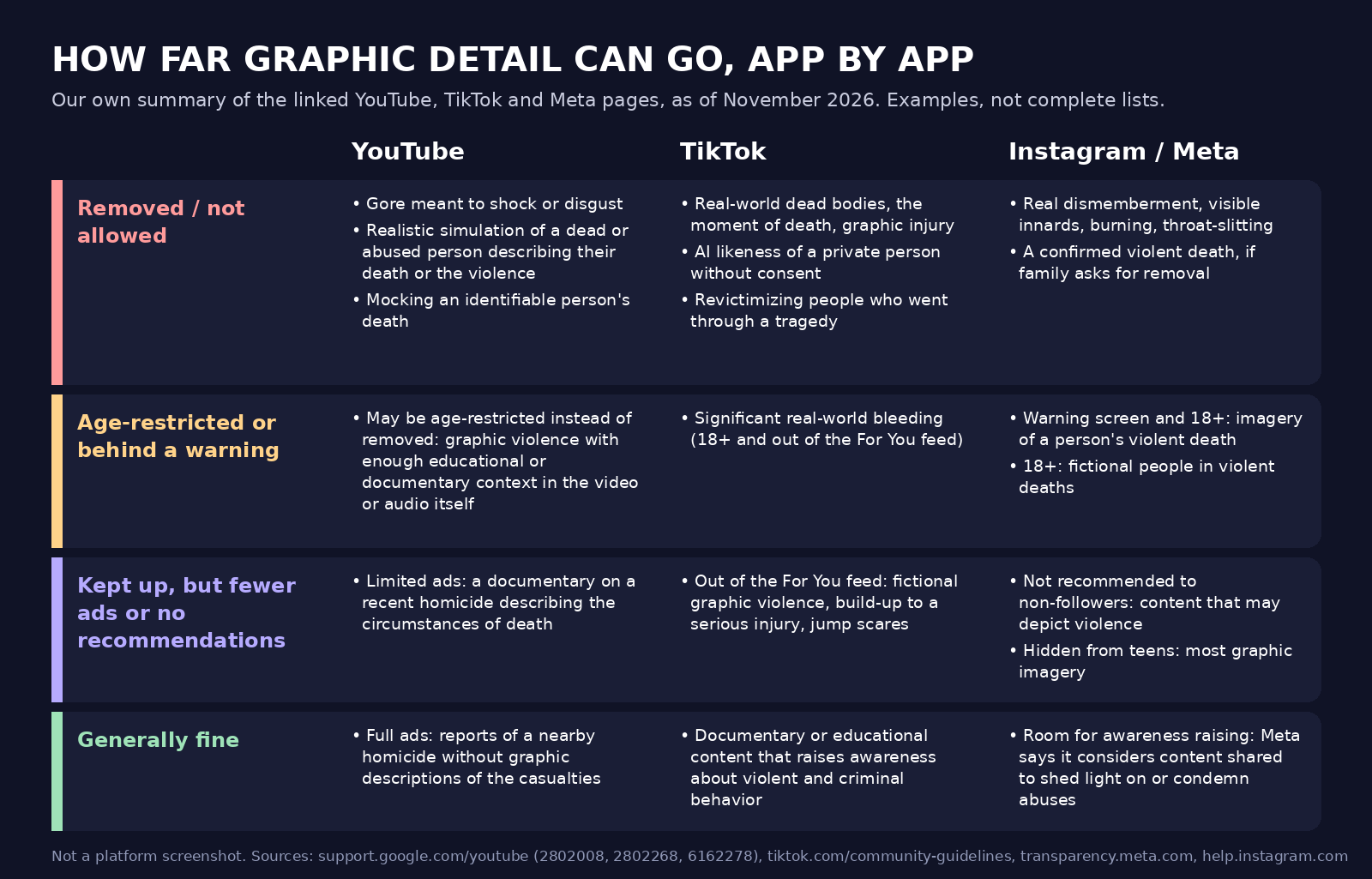
Our own diagram summarizing the linked YouTube, TikTok and Meta pages, not a platform screenshot. Examples, not complete lists.
How to tell a real case without crossing the lines
Our advice, built on the rules above: decide the visual approach before generating. With real people, illustrated or clearly stylized visuals beat photographic ones. Never generate a recognizable likeness or voice of a real victim, or make a victim "speak" in the first person.
- Put context in the narration and on screen, not just the title or description.
- Describe what happened, not what the body looked like.
- Keep titles and thumbnails free of gore and shock words; YouTube's rules cover them.
- No praise or fan framing of perpetrators.
- Don't present speculation about identifiable living people as fact; TikTok bans misleading AI linking public figures to crime, and we'd extend that to private people.
- Stick to documented facts and cite them, as we did for a history Short. Our true crime generator page says the same.
When unsure whether a detail is needed, leave it out. Respect for the people in the case is the ethical line and, on these apps, the safer one.
A hypothetical cold-case Short, before and after
Hypothetical: not a real case and not a Blipix customer.
A cold-case channel scripts a 50-second Short about a woman who vanished in 1987. Draft one: a realistic AI "photo" of her narrating her last night in the first person, a crime-scene close-up, and the title "The Gruesome Truth". The revision:
- Third-person narration. With a real victim, draft one would break YouTube's rule on simulating deceased individuals describing their death.
- An early line saying it's a reconstruction based on public records, putting context in the audio and captions, where YouTube requires it.
- Illustrated road and empty-car scenes, no recognizable faces, avoiding the private-figure likeness TikTok bans even when labeled.
- No close-up or description of injuries, avoiding YouTube's "descriptive language" limited-ads example.
- A calm title and thumbnail, which YouTube's content and ad rules both cover.
Since the case is invented, draft one wouldn't break YouTube's real-victim rule, but its realistic look would still need AI labels and could confuse viewers.
Before you post: a six-point checklist
Our advice:
- Is the case told with context inside the video?
- Is any image photographic and readable as a real person from the case?
- Does any line describe injuries or the body in detail?
- Do the title and thumbnail stay calm?
- Could anything read as admiration for the perpetrator or blame of the victim?
- Would the victim's family see it as respectful?
What this means if you use Blipix
Blipix is our product, a faceless video generator. Our AI true crime video generator page is built for case timelines, cold cases and courtroom stories; this article covers the platform rules it doesn't.
Blipix runs your own script or prompt through an automated moderation check before generating. It lets violent themes through on purpose, because horror and true crime are formats we support, and stops scripts flagged for other categories, such as harassment or hate. So it won't stop a graphic script: the line on detail is your call.
Of our 39 art styles, Cinematic, Photo Realism and the default Blipix style are photographic; Watercolor, Comic Book and Dark Anime are illustrated. Dark Noir, a black-and-white 1940s detective-film look built for detective stories and true crime, can still pass for a photograph in our reading, so treat it as photographic where a real person could be recognized.
In the editor, you can regenerate one scene's image from your own prompt, or use a stock photo on paid plans, if it came out too graphic or too close to a real person. Captions are burned in word by word, timed to the voiceover, so narrated context appears on screen, where YouTube wants it; you can hide them, but for this genre we'd keep them. The built-in narration voices include stock AI voices from ElevenLabs and OpenAI. Don't use voice cloning to recreate a victim's voice, or anyone else's.
When posting to YouTube, Blipix sends the title, description, visibility and comment setting and marks the video as not made for kids, but doesn't set the altered or synthetic disclosure; for realistic scenes, set it in YouTube Studio. Blipix sets TikTok's AI-generated flag on every post it publishes for you; that covers labeling, but doesn't make a victim likeness or graphic scene acceptable.
Running a Series on YouTube autopilot? Review each episode before its slot, check names, dates and claims, and delete any that isn't right; it won't post. Near-identical case videos also raise a separate repetitive-content question.
FAQ
Is true crime allowed on YouTube Shorts and TikTok?
Yes, within limits. YouTube wants context inside the video; TikTok removes real-world dead bodies and graphic injury and bans glorifying violence.
Can I use AI to show the victim telling their own story?
Not for a real victim. YouTube bans realistic simulations of deceased people describing their death, and TikTok bans private figures' likeness without consent. Instagram's pages we read don't address it.
Will a true crime video lose ads on YouTube?
It can. Non-graphic reports can earn ads, descriptive language about a death can limit them, and gore without context earns none.
Does adding "for educational purposes" to the description protect me?
No. For graphic educational content, YouTube says title or description context is insufficient; it must be in the video or audio. Comments and tags may not count either.
What can a victim's family do about a video?
On YouTube, a close family member can file a privacy claim for someone who has died. Meta removes imagery or audio of a confirmed violent death at a family member's request.