If you make UGC-style product clips with an AI actor (a stock AI face, your own AI avatar or an uploaded photo of a person) for TikTok, Reels, Shorts or paid ads, you've probably asked three things. Can it talk like a customer? Must you say it's AI? Is the platform's label enough?
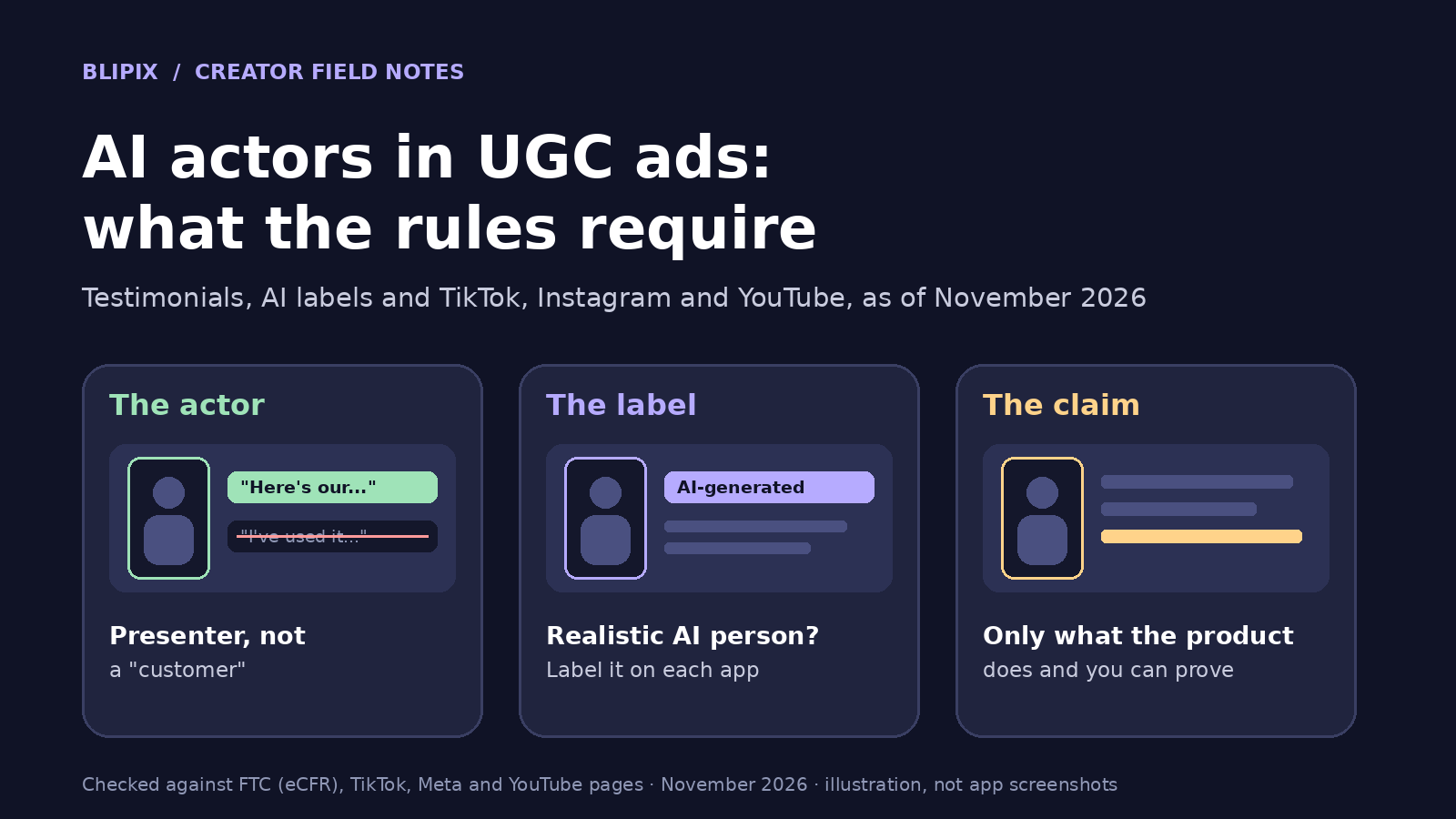
AI actors in ads aren't banned. Two separate questions decide whether a clip is OK. The first is who the actor is presented as: a real customer sharing an experience, or a presenter speaking for the brand. That's a truth-in-advertising question. The second is whether a realistic AI person needs an AI label, which is a platform-rules question. A label answers the second question, not the first.
We use the US Federal Trade Commission's written rules, which are the most specific about testimonials, plus the linked platform pages, as of November 2026. This isn't legal advice. Other countries have their own consumer-protection rules, and a lawyer is the right person for a specific campaign.
The FTC's fake-review rule and AI testimonials
The FTC's Rule on the Use of Consumer Reviews and Testimonials, 16 CFR Part 465, has been in effect since October 21, 2024. It defines a consumer testimonial as a promotional message, including depictions of someone's "likeness", that consumers are likely to believe reflects the "experiences of a consumer who has purchased, used, or otherwise had experience with a product".
Under §465.2(a), it is unfair or deceptive for a business "to write, create, or sell" a testimonial that materially misrepresents "That the reviewer or testimonialist exists", that they used the product, or what their experience was. Section 465.2(b) extends this to businesses that disseminate such a testimonial when they "knew or should have known" it misrepresented those things. A celebrity testimonial is defined the same way for "a well-known individual", and the definition also covers likeness.
Our reading: an AI actor saying "I've used this for a month" is a consumer testimonial from someone who doesn't exist and never used the product. The rule doesn't carve out AI, and it names "create", which is what generating a clip does.
The Endorsement Guides: real users, proof and clear disclosure
The FTC's Endorsement Guides, 16 CFR Part 255, were revised on July 26, 2023. They apply when the endorser "could be or appear to be an individual, group, or institution". Endorsements must reflect "honest opinions". If an ad says the endorser uses the product, "the endorser must have been a bona fide user of it at the time the endorsement was given."
The key line is §255.2(c): ads with endorsements "represented, expressly or by implication, to be “actual consumers” should utilize actual consumers in both the audio and video, or clearly and conspicuously disclose that the persons in such advertisements are not actual consumers of the advertised product."
Example 3 shows the presenter route. An announcer known only "as a spokesperson for the advertising drug company" speaks "on behalf of the drug company", so "The announcer's statements would not be considered an endorsement."
Claims still need "adequate substantiation", and "Consumer endorsements themselves are not competent and reliable scientific evidence."
A clear and conspicuous disclosure is "difficult to miss (i.e., easily noticeable) and easily understandable by ordinary consumers". If the claim is made in both picture and sound, the disclosure belongs in both. Example 10 describes a TV ad that "discloses via both audio and visual means that the persons featured are actors." The fake-review rule adds that on social media "the disclosure must be unavoidable", so viewers shouldn't have to click or hover to see it.
Customer voice vs presenter voice: decide the actor's role first
Our advice: decide the actor's role before writing the script. A presenter can say what the product is and does. Only a real customer can say what it did for them.
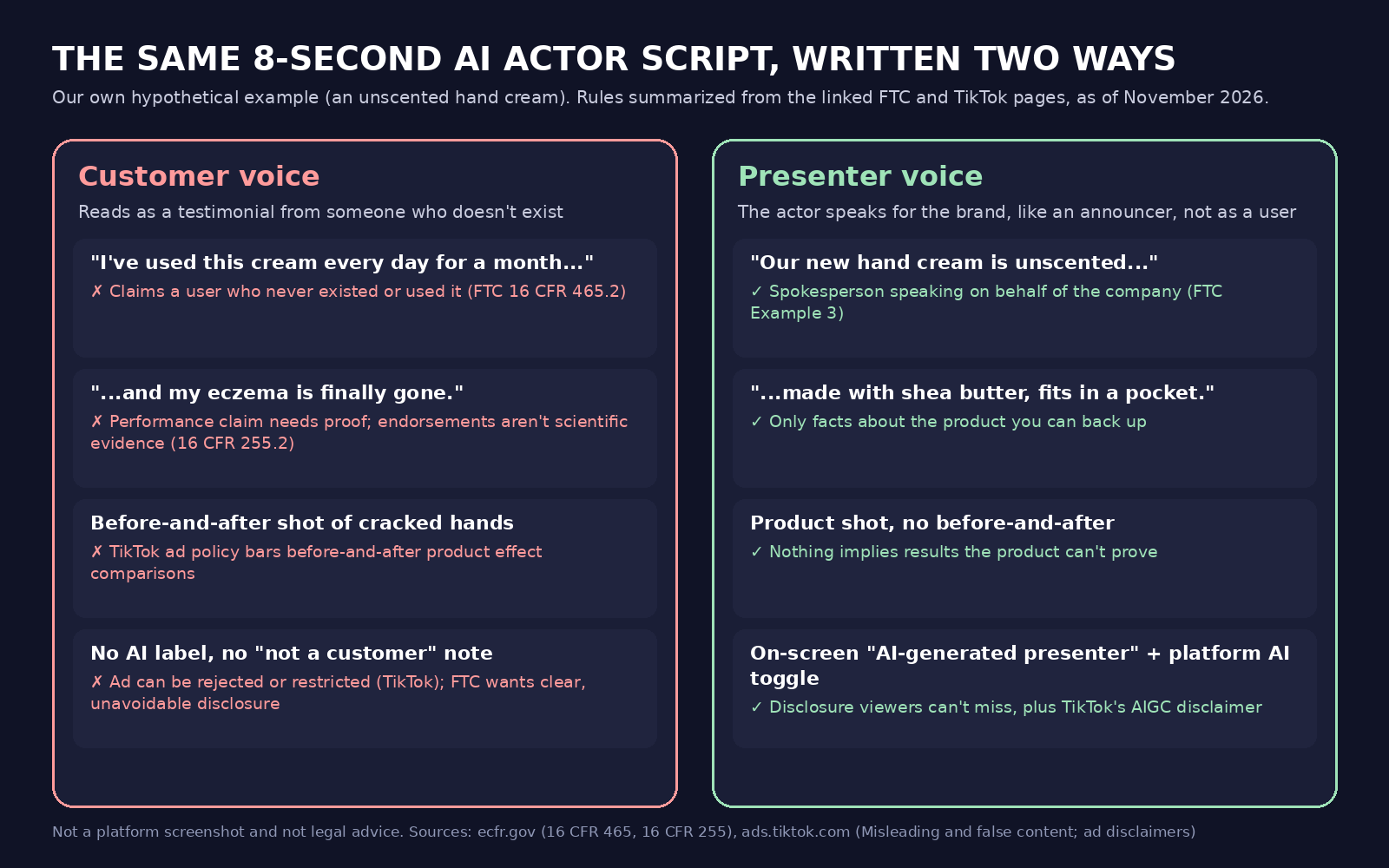 Our own example script, not a platform screenshot. Hypothetical product; the rules are summarized from the linked FTC and TikTok pages.
- Write the AI actor as a presenter for the brand ("we", "our", "here's what's in it"), never as a customer ("I've been using", "my skin", "changed my life").
- For customer stories, use real customers who actually used the product, and disclose any material connection (see disclosing sponsored Shorts, TikToks and Reels).
- If an ad is built to look like a customer moment, say on screen and out loud that the person is an AI actor, not a customer (§255.2(c), Example 10).
Our reading: a disclosure doesn't rescue invented results or a made-up experience. Keep claims to what the product does and what you can prove.
TikTok: organic AI labels and the ad toggle
Organic posts. TikTok's Community Guidelines were released August 25, 2026 and took effect September 24, 2026. They say "we require creators to label AI-generated or significantly edited content that shows realistic-looking scenes or people", using the AIGC label or your own caption, sticker or watermark. The exemption for generic text-to-speech narration doesn't cover a realistic-looking person, so our reading is: label an AI actor.
Even with a label, TikTok bans "Using the likeness of private figures without consent" and AIGC showing a public figure "supporting products" they haven't addressed. It also bans "Pretending to be a fake person or organization with the goal of misleading people" and trading in "Fake reviews". Our reading: passing off an AI actor as a real everyday customer leans toward the fake-person rule. If the product is your own, TikTok also wants its commercial content disclosure turned on (see the sponsored-posts guide).
Ads. TikTok's ad policy on misleading content, last updated November 2026, allows fully AI-generated video if you apply the AIGC label or your own clear disclaimer, caption or watermark. The policy warns: "If we identify AI-generated content that has not been disclosed, your ad will be rejected or restricted." Using a public figure's likeness needs their permission, and "making a false endorsement" isn't allowed. Ads that use a private figure's likeness without permission are removed. Ads "must not promise or exaggerate results concerning a product's effect", and the policy gives before-and-after wrinkle shots as an example of what's not allowed.
TikTok's Ads Manager help on disclaimers (last updated September 2025) explains when the disclaimer applies. Ads that aren't Spark Ads need it when they include content that is "either completely AI-generated or significantly modified by AI". Spark Ads live organically, so the Community Guidelines apply to them instead.
To add the disclaimer, you "check the toggle This ad contains AI-generated content". After you submit, you can't unselect it unless you change the video or image. Also, "Any new campaign creation, including campaign duplication, will reset the AI-generated content disclaimer toggle". Check the toggle again on every duplicated campaign.
Instagram and Facebook ads: Meta's "AI info" label
Meta's help page on AI info for ads says Meta will "automatically label ad content that has been created or edited using some of Meta’s generative AI tools or with third-party generative AI tools". For third-party tools, the label appears when Meta detects the AI, for example through C2PA. The AI info label sits behind "the three-dot menu, selecting About this ad". In the European Region, California, New York, India and Taiwan, advertisers can currently self-disclose, which puts the label "next to the Sponsored label". Organic brand posts follow Meta's rules for organic content (see our guide to labeling AI-generated videos).
Our reading: a label behind a menu is a platform transparency label, not the "unavoidable" disclosure the FTC describes. It doesn't replace saying the actor isn't a customer when the ad implies one.
YouTube and Shorts: answer Yes to "AI use"
YouTube's Disclosing use of GenAI content page says: "We require creators to disclose AI-generated or altered content that seems realistic." That includes content that "Generates a realistic scene that didn’t actually occur."
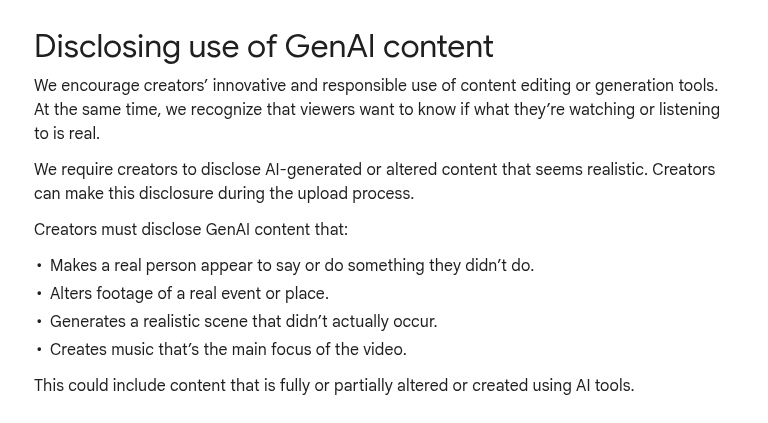 Cropped screenshot of YouTube's public Help Center page "Disclosing use of GenAI content", taken November 17, 2026.
In YouTube Studio during upload, "In the Attributes section, under “AI use,” tap Yes". Creators who consistently skip disclosure risk penalties, including removal of content or suspension from the YouTube Partner Program.
Our reading: a photorealistic AI actor talking to camera is a realistic scene that didn't occur, so answer Yes. Posting dozens of near-identical AI ad clips organically raises a separate repetitive-content question. We didn't review Google Ads policies for running a clip as a YouTube ad, so check them before launching one.
The rules side by side
| AI actor speaking as a customer | AI label needed? | Who adds the label | Real people's faces | |
|---|---|---|---|---|
| FTC (US, any ad) | Fake testimonial unless a real customer; disclose "not actual consumers" | Not an AI-label rule; disclosure must be clear and unavoidable | You, in the ad itself | Celebrity testimonial covers likeness |
| TikTok organic post | Fake persons and fake reviews not allowed | Yes, if realistic-looking | You: AIGC label or own caption or sticker | Private figures need consent; no fake public-figure product support |
| TikTok ad | No exaggerated results | Yes: AIGC label or own clear disclaimer | You: toggle in Ads Manager (Spark Ads follow organic rules) | Public figures need permission; no false endorsements |
| Instagram/Facebook ad | Not addressed on the pages we read | Auto "AI info" when detected | Meta, behind About this ad; self-disclosure in some regions | Not addressed on the pages we read |
| YouTube video | Not addressed on the pages we read | Yes if realistic | You: "AI use" in Studio | Disclose if a real person seems to say or do what they didn't |
A hypothetical example: fixing an 8-second hand cream ad
This is hypothetical, not a real brand and not a Blipix customer. A shop selling an unscented hand cream makes an 8-second TikTok ad. In the first draft, a stock AI actor says "I've used this cream every day for a month and my eczema is finally gone, best thing I've bought all year" over a before-and-after of cracked hands. The ad runs without the AI toggle. Here's what the revised version changes:
- The actor speaks as the brand: "Our new hand cream is unscented, made with shea butter, and fits in a jacket pocket." The old line came from a testimonialist who doesn't exist and never used the product (§465.2). It also wasn't a bona fide user speaking, and it presented the actor as an actual consumer (§255.2(c)).
- The eczema claim is gone. It would need substantiation, a testimonial isn't scientific evidence, and TikTok bars exaggerated results.
- The before-and-after is gone, since TikTok's ad policy lists that kind of comparison as not allowed.
- On-screen text reads "AI-generated presenter". Viewers see it without tapping anything, which is what the FTC's clear and conspicuous standard asks for (our reading), and it uses TikTok's own-disclaimer option.
- The "This ad contains AI-generated content" toggle is on, as TikTok's Ads Manager help asks for fully AI-generated ads. The shop checks it again after duplicating the campaign.
A checklist before you publish an AI UGC ad
Our advice:
- Does the actor ever speak as a customer?
- Is every claim something the product does and you can back up?
- Is the AI disclosed where viewers will see it: on screen, and spoken too if the ad implies a real customer?
- Is the platform's AI toggle or label on, and still on after duplicating a campaign?
- Is every real person in the clip someone who agreed in writing?
- Does the clip avoid any famous face or voice?
When in doubt, label. Put disclosures where viewers can't miss them, not behind a menu or in the caption's "more".
What this means if you use Blipix
Blipix is our product. Here's how all this applies to it, including where our own defaults lean the wrong way.
In our UGC Ad template, you pick an actor: a stock AI actor from the library, an AI avatar you made in Blipix, or a photo you upload. You can add a product photo up to 10 MB, then write at least 10 words and choose 4, 6 or 8 seconds. Google's Veo 3.1 generates the picture and the voice together, and each take costs 50 credits.
- Every stock actor in the library is AI-generated, not a real customer, so a stock actor can never truthfully give a customer testimonial. Write them as a presenter.
- Upload only photos of people who agreed to appear in your ads, ideally in writing. The upload step doesn't ask about consent, so that check is yours.
- The AI Script Writer drafts a hook, one benefit and a call to action, written to sound like someone talking to camera. The example text in the script box is written like a customer ("I've been using this product for the past month"). Treat both as drafts, and rewrite any line where the actor claims to have used the product.
- About 24 to 38 words fit an 8-second take, so a spoken disclosure takes real space. An on-screen text label plus the platform's own label is usually the practical way.
- Our ecommerce page already says not to script an AI actor as a customer who has used the product for a month. This article is the longer version of that habit.
- When the editor posts a clip to TikTok for you, Blipix sets TikTok's AI-generated flag. It doesn't set TikTok's commercial content disclosure, so for your own product, check that in the TikTok app.
- When Blipix posts to YouTube, it sends the title, description, visibility and comment setting and marks the video as not made for kids. It doesn't set YouTube's AI use disclosure, so set "AI use" in YouTube Studio.
- When Blipix posts a Reel to Instagram, it doesn't add any AI or paid partnership label.
- Blipix doesn't create or submit paid ads. To run a clip as a TikTok or Meta ad, you download the MP4 and upload it in the ad tools yourself. That means TikTok's AI toggle, and Meta's self-disclosure where it's offered, are yours to set.
Agencies making clips for clients carry the same responsibility. The Endorsement Guides say agencies "may be liable" for endorsements they "know or should know are deceptive".
FAQ
Can I use an AI actor in a UGC ad?
Yes. What matters is whether the actor is presented as a customer and whether the AI is labeled where the platform requires it.
Can an AI actor say "I love this product"?
Only as an obvious brand presenter, like the announcer in Example 3 of the Endorsement Guides. Said as a customer who used the product, it's a testimonial from someone who doesn't exist and was never a bona fide user.
Is TikTok's or Meta's AI label enough?
It answers the AI question, not the testimonial question. Meta's label also sits behind About this ad, and the FTC says disclosures on social media must be unavoidable.
Do I have to label an AI actor on YouTube Shorts?
If the actor looks realistic, yes. Choose Yes under "AI use" in YouTube Studio.
Can I put a real person's or a celebrity's face on the actor?
Only someone who has agreed to it. TikTok bans using a private figure's likeness without consent and false public-figure endorsements in both posts and ads, and the FTC's celebrity testimonial definition includes "likeness".